

 Product
 Brand
 Articles
 Tools

MCP2200 Converter: Features, Pinout, and Datasheet

3V~5.5V USB 2.0 UART Controllers Interface ICs DUAL MCP2200 20 Pins Bridge, USB to UART 20-SOIC (0.295, 7.50mm Width)


3V~5.5V USB 2.0 UART Controllers Interface ICs DUAL MCP2200 20 Pins Bridge, USB to UART 20-SOIC (0.295, 7.50mm Width)
The MCP2200 is a USB-to-UART serial converter that enables USB communication in UART-equipped applications. This article mainly introduces features, pinout, datasheet and other information about Microchip Technology MCP2200.

Cheap USB to UART (RS232/Serial) Converter Using Microchip MCP2200
MCP2200 Description
The MCP2200 is a USB-to-UART serial converter that enables USB communication in UART-equipped applications. The USB termination resistors are integrated within the device, which decreases the number of external components. The MCP2200 additionally includes a 256-byte user EEPROM.
Eight general-purpose input/output pins are available on the MCP2200. Four pins serve as alternate indicators of USB and communication status.
MCP2200 Pinout

Pinout
| Pin Number | Pin Name | Description |
| 16 | GP0/SSPND | General purpose I/O |
| 15 | GP1/USBCFG | General purpose I/O |
| 14 | GP2 | General purpose I/O |
| 9 | GP3 | General purpose I/O |
| 8 | GP4 | General purpose I/O |
| 7 | GP5 | General purpose I/O |
| 6 | GP6/RxLED | General purpose I/O |
| 5 | GP7/TxLED | General purpose I/O |
| 4 | RST | Reset input must be externally biased |
| 13 | CTS | Hardware flow control “Clear to Send” input signal |
| 12 | RX | USART RX input |
| 11 | RTS | Hardware flow control “Request to Send” output signal |
| 10 | TX | USART TX output |
| 1 | VDD | Power |
| 20 | VSS | Ground |
| 2 | OSC1 | Oscillator input |
| 3 | OSC2 | Oscillator output |
| 19 | D+ | USB D+ |
| 18 | D- | USB D- |
| 17 | VUSB | USB power pin (internally connected to 3.3V). Should be locally bypassed with a high quality ceramic capacitor. |
MCP2200 CAD Model

Symbol
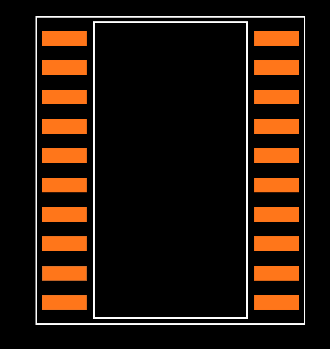
Footprint

3D Model
MCP2200 Features
(1) Universal Serial Bus (USB)
• Supports full-speed USB (12 Mb/s)
• Implements USB protocol composite device CDC device for communications, configuration and I/O control
• 128-byte buffer to handle data throughput at any UART baud rate:
- 64 byte transmit
- 64-byte receive
• Fully configurable VID and PID assignments, and string descriptors
• Bus-powered or self-powered
• USB 2.0 Compliant (certification #: TBD)
(2) USB Driver and Software Support
• Uses standard Microsoft® Windows® drivers for Virtual Com Port (VCP):
- Windows XP(SP2 and later)/Vista/7
• Configuration utility for initial configuration
(3) Universal Asynchronous Receiver/Transmitter (UART)
• Responds to SET LINE CODING commands to dynamically change baud rates
• Supports baud rates: 300-1000k
• Hardware flow control
• UART signal polarity option
(4) General Purpose Input/Output (GPIO) Pins
• Eight (8) general-purpose I/O pins
(5) EEPROM
• 256 bytes of user EEPROM
(6) Other
• USB activity LED outputs (TxLED and RxLED)
• SSPND output pin
• USBCFG output pin (indicates if requested current is allowed)
• Operating voltage: 3.0-5.5V
• Oscillator input: 12 MHz
• ESD protection > 4 kV HBM
• Industrial (I) Operating Temperature: -40°C to +85°C
Specifications
- TypeParameter
- Factory Lead Time7 Weeks
- Contact Plating
Contact plating (finish) provides corrosion protection for base metals and optimizes the mechanical and electrical properties of the contact interfaces.
Tin - Mount
In electronic components, the term "Mount" typically refers to the method or process of physically attaching or fixing a component onto a circuit board or other electronic device. This can involve soldering, adhesive bonding, or other techniques to secure the component in place. The mounting process is crucial for ensuring proper electrical connections and mechanical stability within the electronic system. Different components may have specific mounting requirements based on their size, shape, and function, and manufacturers provide guidelines for proper mounting procedures to ensure optimal performance and reliability of the electronic device.
Surface Mount - Package / Case
refers to the protective housing that encases an electronic component, providing mechanical support, electrical connections, and thermal management.
20-SOIC (0.295, 7.50mm Width) - Number of Pins20
- Weight800.987426mg
- Operating Temperature
The operating temperature is the range of ambient temperature within which a power supply, or any other electrical equipment, operate in. This ranges from a minimum operating temperature, to a peak or maximum operating temperature, outside which, the power supply may fail.
-40°C~85°C - Packaging
Semiconductor package is a carrier / shell used to contain and cover one or more semiconductor components or integrated circuits. The material of the shell can be metal, plastic, glass or ceramic.
Tube - JESD-609 Code
The "JESD-609 Code" in electronic components refers to a standardized marking code that indicates the lead-free solder composition and finish of electronic components for compliance with environmental regulations.
e3 - Pbfree Code
The "Pbfree Code" parameter in electronic components refers to the code or marking used to indicate that the component is lead-free. Lead (Pb) is a toxic substance that has been widely used in electronic components for many years, but due to environmental concerns, there has been a shift towards lead-free alternatives. The Pbfree Code helps manufacturers and users easily identify components that do not contain lead, ensuring compliance with regulations and promoting environmentally friendly practices. It is important to pay attention to the Pbfree Code when selecting electronic components to ensure they meet the necessary requirements for lead-free applications.
yes - Part Status
Parts can have many statuses as they progress through the configuration, analysis, review, and approval stages.
Active - Moisture Sensitivity Level (MSL)
Moisture Sensitivity Level (MSL) is a standardized rating that indicates the susceptibility of electronic components, particularly semiconductors, to moisture-induced damage during storage and the soldering process, defining the allowable exposure time to ambient conditions before they require special handling or baking to prevent failures
1 (Unlimited) - Number of Terminations20
- ECCN Code
An ECCN (Export Control Classification Number) is an alphanumeric code used by the U.S. Bureau of Industry and Security to identify and categorize electronic components and other dual-use items that may require an export license based on their technical characteristics and potential for military use.
EAR99 - Voltage - Supply
Voltage - Supply refers to the range of voltage levels that an electronic component or circuit is designed to operate with. It indicates the minimum and maximum supply voltage that can be applied for the device to function properly. Providing supply voltages outside this range can lead to malfunction, damage, or reduced performance. This parameter is critical for ensuring compatibility between different components in a circuit.
3V~5.5V - Terminal Position
In electronic components, the term "Terminal Position" refers to the physical location of the connection points on the component where external electrical connections can be made. These connection points, known as terminals, are typically used to attach wires, leads, or other components to the main body of the electronic component. The terminal position is important for ensuring proper connectivity and functionality of the component within a circuit. It is often specified in technical datasheets or component specifications to help designers and engineers understand how to properly integrate the component into their circuit designs.
DUAL - Terminal Form
Occurring at or forming the end of a series, succession, or the like; closing; concluding.
GULL WING - Peak Reflow Temperature (Cel)
Peak Reflow Temperature (Cel) is a parameter that specifies the maximum temperature at which an electronic component can be exposed during the reflow soldering process. Reflow soldering is a common method used to attach electronic components to a circuit board. The Peak Reflow Temperature is crucial because it ensures that the component is not damaged or degraded during the soldering process. Exceeding the specified Peak Reflow Temperature can lead to issues such as component failure, reduced performance, or even permanent damage to the component. It is important for manufacturers and assemblers to adhere to the recommended Peak Reflow Temperature to ensure the reliability and functionality of the electronic components.
250 - Supply Voltage
Supply voltage refers to the electrical potential difference provided to an electronic component or circuit. It is crucial for the proper operation of devices, as it powers their functions and determines performance characteristics. The supply voltage must be within specified limits to ensure reliability and prevent damage to components. Different electronic devices have specific supply voltage requirements, which can vary widely depending on their design and intended application.
3.3V - Frequency
In electronic components, the parameter "Frequency" refers to the rate at which a signal oscillates or cycles within a given period of time. It is typically measured in Hertz (Hz) and represents how many times a signal completes a full cycle in one second. Frequency is a crucial aspect in electronic components as it determines the behavior and performance of various devices such as oscillators, filters, and communication systems. Understanding the frequency characteristics of components is essential for designing and analyzing electronic circuits to ensure proper functionality and compatibility with other components in a system.
12MHz - Time@Peak Reflow Temperature-Max (s)
Time@Peak Reflow Temperature-Max (s) refers to the maximum duration that an electronic component can be exposed to the peak reflow temperature during the soldering process, which is crucial for ensuring reliable solder joint formation without damaging the component.
40 - Base Part Number
The "Base Part Number" (BPN) in electronic components serves a similar purpose to the "Base Product Number." It refers to the primary identifier for a component that captures the essential characteristics shared by a group of similar components. The BPN provides a fundamental way to reference a family or series of components without specifying all the variations and specific details.
MCP2200 - Function
The parameter "Function" in electronic components refers to the specific role or purpose that the component serves within an electronic circuit. It defines how the component interacts with other elements, influences the flow of electrical signals, and contributes to the overall behavior of the system. Functions can include amplification, signal processing, switching, filtering, and energy storage, among others. Understanding the function of each component is essential for designing effective and efficient electronic systems.
Bridge, USB to UART - Operating Supply Voltage
The voltage level by which an electrical system is designated and to which certain operating characteristics of the system are related.
3.3V - Interface
In electronic components, the term "Interface" refers to the point at which two different systems, devices, or components connect and interact with each other. It can involve physical connections such as ports, connectors, or cables, as well as communication protocols and standards that facilitate the exchange of data or signals between the connected entities. The interface serves as a bridge that enables seamless communication and interoperability between different parts of a system or between different systems altogether. Designing a reliable and efficient interface is crucial in ensuring proper functionality and performance of electronic components and systems.
UART - Operating Supply Current
Operating Supply Current, also known as supply current or quiescent current, is a crucial parameter in electronic components that indicates the amount of current required for the device to operate under normal conditions. It represents the current drawn by the component from the power supply while it is functioning. This parameter is important for determining the power consumption of the component and is typically specified in datasheets to help designers calculate the overall power requirements of their circuits. Understanding the operating supply current is essential for ensuring proper functionality and efficiency of electronic systems.
13mA - Nominal Supply Current
Nominal current is the same as the rated current. It is the current drawn by the motor while delivering rated mechanical output at its shaft.
15mA - Logic Function
In electronic components, the term "Logic Function" refers to the specific operation or behavior of a component based on its input signals. It describes how the component processes the input signals to produce the desired output. Logic functions are fundamental to digital circuits and are used to perform logical operations such as AND, OR, NOT, and XOR.Each electronic component, such as logic gates or flip-flops, is designed to perform a specific logic function based on its internal circuitry. By understanding the logic function of a component, engineers can design and analyze complex digital systems to ensure proper functionality and performance. Different logic functions can be combined to create more complex operations, allowing for the creation of sophisticated digital devices and systems.
Buffer - Data Rate
Data Rate is defined as the amount of data transmitted during a specified time period over a network. It is the speed at which data is transferred from one device to another or between a peripheral device and the computer. It is generally measured in Mega bits per second(Mbps) or Mega bytes per second(MBps).
12 Mbps - Protocol
In electronic components, the parameter "Protocol" refers to a set of rules and standards that govern the communication between devices. It defines the format, timing, sequencing, and error checking methods for data exchange between different components or systems. Protocols ensure that devices can understand and interpret data correctly, enabling them to communicate effectively with each other. Common examples of protocols in electronics include USB, Ethernet, SPI, I2C, and Bluetooth, each with its own specifications for data transmission. Understanding and adhering to protocols is essential for ensuring compatibility and reliable communication between electronic devices.
USB - Telecom IC Type
Telecom IC Type refers to integrated circuits specifically designed for telecommunications applications. These components facilitate various functions such as signal processing, data modulation and demodulation, and communication protocol handling. They can be used in devices like mobile phones, modems, and network equipment, ensuring reliable data transmission and reception. Telecom ICs support different standards and technologies, making them essential for modern communication systems.
INTERFACE CIRCUIT - ESD Protection
ESD protection, or Electrostatic Discharge protection, is a feature in electronic components designed to prevent damage caused by sudden electrostatic discharges. These discharges can occur when a person or object with an electric charge comes into contact with a sensitive electronic component, leading to a rapid flow of static electricity that can damage or destroy the component. ESD protection mechanisms in electronic components typically involve the use of special materials or circuitry that can safely dissipate or divert the excess charge away from the sensitive components, thus safeguarding the device from potential harm. Implementing effective ESD protection is crucial in ensuring the reliability and longevity of electronic devices, especially in environments where static electricity buildup is common, such as in manufacturing facilities or areas with low humidity.
Yes - Standards
The parameter "Standards" in electronic components refers to established criteria or specifications that ensure interoperability, safety, and performance across various electronic devices and systems. These standards are often set by recognized organizations and describe the characteristics, dimensions, and testing methods for components. Adherence to these standards helps manufacturers produce compatible and reliable products, facilitates communication between devices, and ensures compliance with regulatory requirements. Standards play a crucial role in the consistency and quality of electronic components in the industry.
USB 2.0 - Number of Receivers1
- Height2.05mm
- Length12.8mm
- Width7.5mm
- REACH SVHC
The parameter "REACH SVHC" in electronic components refers to the compliance with the Registration, Evaluation, Authorization, and Restriction of Chemicals (REACH) regulation regarding Substances of Very High Concern (SVHC). SVHCs are substances that may have serious effects on human health or the environment, and their use is regulated under REACH to ensure their safe handling and minimize their impact.Manufacturers of electronic components need to declare if their products contain any SVHCs above a certain threshold concentration and provide information on the safe use of these substances. This information allows customers to make informed decisions about the potential risks associated with using the components and take appropriate measures to mitigate any hazards.Ensuring compliance with REACH SVHC requirements is essential for electronics manufacturers to meet regulatory standards, protect human health and the environment, and maintain transparency in their supply chain. It also demonstrates a commitment to sustainability and responsible manufacturing practices in the electronics industry.
No SVHC - Radiation Hardening
Radiation hardening is the process of making electronic components and circuits resistant to damage or malfunction caused by high levels of ionizing radiation, especially for environments in outer space (especially beyond the low Earth orbit), around nuclear reactors and particle accelerators, or during nuclear accidents or nuclear warfare.
No - RoHS Status
RoHS means “Restriction of Certain Hazardous Substances” in the “Hazardous Substances Directive” in electrical and electronic equipment.
ROHS3 Compliant - Lead Free
Lead Free is a term used to describe electronic components that do not contain lead as part of their composition. Lead is a toxic material that can have harmful effects on human health and the environment, so the electronics industry has been moving towards lead-free components to reduce these risks. Lead-free components are typically made using alternative materials such as silver, copper, and tin. Manufacturers must comply with regulations such as the Restriction of Hazardous Substances (RoHS) directive to ensure that their products are lead-free and environmentally friendly.
Lead Free
MCP2200 Functional Block Diagram

Functional Block Diagram
How to use MCP2200 Converter
There is a PCB that has an LM1117 (3.3V), Micro USB connector, MCP2200 USB-to-UART bridge, 12 MHz SMD crystal, and a few passive components.
We've been watching the PCB for a few weeks and have noticed that it doesn't always work. When I connect to a machine, it occasionally displays an error message such as "USB Device not recognized" (in Windows) or "Device read/write descriptor failed" (in Linux), and then it stops working for hours before restarting. I looked through my circuit and couldn't come up with a solution to this problem. We ruled out a soldering/component issue after resoldering the board and replacing old components many times. I believe the crystal is unable to start, or that there is a race condition between the voltage at Vcc and the voltage at the RST pin, but I'm not sure how to identify the real issue and address it with MCP.
The MCP2200 schematic is provided below:

The layout of the PCB: MCP2200's Pad is in green and left side of the picture with USB connector at top left corner.
MCP2200 Oscillator
The input clock must be 12 MHz to provide the proper frequency for the USB module. USB full-speed is nominally 12 Mb/s. The clock input accuracy is ±0.25% (2,500 ppm maximum).

Quartz Crystal Operation

Ceramic Resonator Operation
MCP2200 Alternatives
| Part Number | Description | Manufacturer |
| MCP2200T-I/SSVAOTELECOMMUNICATION CIRCUITS | Interface Circuit, PDSO20 | Microchip Technology Inc |
| MCP2200T-I/SSTELECOMMUNICATION CIRCUITS | DATACOM, INTERFACE CIRCUIT, PDSO20, 5.30 MM, LEAD FREE, PLASTIC, SSOP-20 | Microchip Technology Inc |
| MCP2200-E/SSTELECOMMUNICATION CIRCUITS | Interface Circuit, PDSO20 | Microchip Technology Inc |
MCP2200 Applications
• Desktop/Notebook PCs
• Multi-function Printers
• Digital TVs
• Monitors
• Consumer Audio/Video Devices
• Stand-alone Flash Media Reader/Writers
• Digital Picture Frames
• Media Players
• Set-top Boxes
• Gaming Consoles
• Automobile/Home Audio Systems
• Industrial Applications
MCP2200 Package

Package
MCP2200 Manufacturer
Microchip Technology Incorporated is a leading manufacturer of smart, networked, and secure embedded control solutions. Customers may create optimal designs using the company's simple development tools and broad product choices, which reduce risk while lowering overall system costs and time to market. The company's technologies are used by over 120,000 clients in the industrial, automotive, consumer, aerospace and defense, communications, and computing sectors. Microchip, based in Chandler, Arizona, offers outstanding technical support as well as dependable delivery and quality.
Trend Analysis
Datasheet PDF
- Datasheets :
- PCN Design/Specification :
- PCN Packaging :
- ConflictMineralStatement :
 CD74HCT40103: High-Speed CMOS Logic 8-Stage Synchronous Down Counter
26 February 20221014
 A1266 3D Hall-Effect Switch: Datasheet, Equivalent and Pinout
20 October 20212363
 IRF620 N-Channel Power MOSFET: Datasheet pdf, 6A 200V MOSFET and Pinout
24 December 20213379
 Texas Instruments MSP430F1101IPW Microcontroller Datasheet Overview
28 February 2024314
 ADG1419 iCMOS SPDT Switch: Pinout, Features and Datasheet
15 February 20224026
 PSoC® 4: PSoC 4200M Microcontroller - Technical Overview and Applications
29 February 2024492
 2N5551 Transistor: Pinout, Datasheet, and Applications
09 July 202114771
 LTC6605CDJC-14#TRPBF Active Filter: Product Overview and Applications
06 March 2024199
 Strain Gauges: Structure, Working Principle and Common Types
16 December 202014438
 Degson Authorized Distributor | UTMEL Electronics
21 November 20234283
 Introduction to DDIC (Display Driver IC)
07 August 202636198
 2nm vs 3nm Chips: What the Latest Process Nodes Mean for Performance
19 August 20262196
 Introduction to Flyback Transformer
29 January 202112221
 Hall Effect: Definition, Principle, Measurement Methods
08 November 202211986
 What is Server and Why does a Server Crash?
14 September 202119099
 Basic Introduction to Power Amplifier
09 January 202611066
Microchip Technology
In Stock
United States
China
Canada
Japan
Russia
Germany
United Kingdom
Singapore
Italy
Hong Kong(China)
Taiwan(China)
France
Korea
Mexico
Netherlands
Malaysia
Austria
Spain
Switzerland
Poland
Thailand
Vietnam
India
United Arab Emirates
Afghanistan
Åland Islands
Albania
Algeria
American Samoa
Andorra
Angola
Anguilla
Antigua & Barbuda
Argentina
Armenia
Aruba
Australia
Azerbaijan
Bahamas
Bahrain
Bangladesh
Barbados
Belarus
Belgium
Belize
Benin
Bermuda
Bhutan
Bolivia
Bonaire, Sint Eustatius and Saba
Bosnia & Herzegovina
Botswana
Brazil
British Indian Ocean Territory
British Virgin Islands
Brunei
Bulgaria
Burkina Faso
Burundi
Cabo Verde
Cambodia
Cameroon
Cayman Islands
Central African Republic
Chad
Chile
Christmas Island
Cocos (Keeling) Islands
Colombia
Comoros
Congo
Congo (DRC)
Cook Islands
Costa Rica
Côte d’Ivoire
Croatia
Cuba
Curaçao
Cyprus
Czechia
Denmark
Djibouti
Dominica
Dominican Republic
Ecuador
Egypt
El Salvador
Equatorial Guinea
Eritrea
Estonia
Eswatini
Ethiopia
Falkland Islands
Faroe Islands
Fiji
Finland
French Guiana
French Polynesia
Gabon
Gambia
Georgia
Ghana
Gibraltar
Greece
Greenland
Grenada
Guadeloupe
Guam
Guatemala
Guernsey
Guinea
Guinea-Bissau
Guyana
Haiti
Honduras
Hungary
Iceland
Indonesia
Iran
Iraq
Ireland
Isle of Man
Israel
Jamaica
Jersey
Jordan
Kazakhstan
Kenya
Kiribati
Kosovo
Kuwait
Kyrgyzstan
Laos
Latvia
Lebanon
Lesotho
Liberia
Libya
Liechtenstein
Lithuania
Luxembourg
Macao(China)
Madagascar
Malawi
Maldives
Mali
Malta
Marshall Islands
Martinique
Mauritania
Mauritius
Mayotte
Micronesia
Moldova
Monaco
Mongolia
Montenegro
Montserrat
Morocco
Mozambique
Myanmar
Namibia
Nauru
Nepal
New Caledonia
New Zealand
Nicaragua
Niger
Nigeria
Niue
Norfolk Island
North Korea
North Macedonia
Northern Mariana Islands
Norway
Oman
Pakistan
Palau
Palestinian Authority
Panama
Papua New Guinea
Paraguay
Peru
Philippines
Pitcairn Islands
Portugal
Puerto Rico
Qatar
Réunion
Romania
Rwanda
Samoa
San Marino
São Tomé & Príncipe
Saudi Arabia
Senegal
Serbia
Seychelles
Sierra Leone
Sint Maarten
Slovakia
Slovenia
Solomon Islands
Somalia
South Africa
South Sudan
Sri Lanka
St Helena, Ascension, Tristan da Cunha
St. Barthélemy
St. Kitts & Nevis
St. Lucia
St. Martin
St. Pierre & Miquelon
St. Vincent & Grenadines
Sudan
Suriname
Svalbard & Jan Mayen
Sweden
Syria
Tajikistan
Tanzania
Timor-Leste
Togo
Tokelau
Tonga
Trinidad & Tobago
Tunisia
Turkey
Turkmenistan
Turks & Caicos Islands
Tuvalu
U.S. Outlying Islands
U.S. Virgin Islands
Uganda
Ukraine
Uruguay
Uzbekistan
Vanuatu
Vatican City
Venezuela
Wallis & Futuna
Yemen
Zambia
Zimbabwe
![KSZ8895MQXIA]() KSZ8895MQXIA
Microchip Technology
![USB2514BI-AEZG]() USB2514BI-AEZG
Microchip Technology
![USB2514B-AEZC-TR]() USB2514B-AEZC-TR
Microchip Technology
![MCP2515-I/ST]() MCP2515-I/ST
Microchip Technology
![MCP2515-I/SO]() MCP2515-I/SO
Microchip Technology
![ENC28J60-I/SS]() ENC28J60-I/SS
Microchip Technology
![KSZ8873MMLI]() KSZ8873MMLI
Microchip Technology
![KSZ8863RLLI]() KSZ8863RLLI
Microchip Technology
![KSZ8863MLL]() KSZ8863MLL
Microchip Technology


