

 Product
 Brand
Brand Articles
 Tools
Tools
MIC803 3-Pin Microprocessor Supervisor Circuit: Pinout, Equivalent and Datasheet


MIC803 Voltage supervisor
The MIC803 is a single-voltage supervisor with open-drain reset output that provides accurate power supply monitoring and reset generation in microprocessor-based systems. Furthermore, Huge range of Semiconductors, Capacitors, Resistors and IcS in stock. Welcome RFQ.

What is a Voltage Supervisor?
MIC803 Pinout
The following figure is the diagram of MIC803 pinout.

Pinout
The following is the Pin Description of MIC803.
| Pin Number | Pin Name | Pin Function |
| 1 | GND | Ground Pin. |
| 2 | /RESET | /RESET goes low if Vcc falls below the reset threshold (VTH), and remains asserted for one timeout period after Vcc exceeds VTH. |
| 3 | Vcc | Power Supply Input and Monitored Voltage. |
MIC803 CAD Model
The following is the Footprint of MIC803.
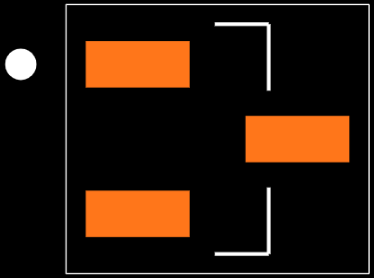
Footprint
MIC803 Overview
The MIC803 is a single-voltage supervisor with open-drain reset output that provides accurate power supply monitoring and reset generation in microprocessor-based systems. The function of the device is to assert a reset signal if the power supply voltage drops below the reset threshold voltage, and retain this reset for the reset timeout period once the power supply increases above the reset threshold voltage. The MIC803 consumes only 4.5μA of supply current and offers three reset delay periods of 20ms, 140ms, and 1120ms (minimum). It features factory-programmed reset threshold levels from 2.63V to 4.63V to accommodate 3.0V, 3.3V, and 5.0V power supplies. It is available in the compact 3-pin SC-70 and SOT-23 packages.
This article provides you with a basic overview of the MIC803 3-Pin Microprocessor Supervisor Circuit, including its pin descriptions, features and specifications, etc., to help you quickly understand what MIC803 is.
MIC803 Features
● 4.5μA supply current (typical) at 3.6V
● Open-drain /RESET output
● /RESET remains valid with Vcc as low as 1V
● 20ms, 140ms, or 1120ms (minimum) reset timeout options
● 2.63V to 4.63V preset voltage threshold options
● 2.5% voltage threshold accuracy over temperature
● 3-pin SC70-3 package (2.0mm x 2.1mm)
● 3-pin SOT-23 package (2.3mm x 2.9mm)
● -40°C to +125°C junction temperature range
Specifications
- TypeParameter
- Factory Lead Time7 Weeks
- Mounting Type
The "Mounting Type" in electronic components refers to the method used to attach or connect a component to a circuit board or other substrate, such as through-hole, surface-mount, or panel mount.
Surface Mount - Package / Case
refers to the protective housing that encases an electronic component, providing mechanical support, electrical connections, and thermal management.
TO-236-3, SC-59, SOT-23-3 - Number of Pins3
- Supplier Device Package
The parameter "Supplier Device Package" in electronic components refers to the physical packaging or housing of the component as provided by the supplier. It specifies the form factor, dimensions, and layout of the component, which are crucial for compatibility and integration into electronic circuits and systems. The supplier device package information typically includes details such as the package type (e.g., DIP, SOP, QFN), number of pins, pitch, and overall size, allowing engineers and designers to select the appropriate component for their specific application requirements. Understanding the supplier device package is essential for proper component selection, placement, and soldering during the manufacturing process to ensure optimal performance and reliability of the electronic system.
SOT-23-3 - Operating Temperature (Max)
The parameter "Operating Temperature (Max)" in electronic components refers to the maximum temperature at which the component can safely operate without experiencing damage or performance degradation. This specification is crucial for ensuring the reliability and longevity of the component in various operating conditions. Exceeding the maximum operating temperature can lead to thermal stress, reduced efficiency, and ultimately failure of the component. It is important for designers and engineers to consider this parameter when selecting and using electronic components to ensure proper functionality and prevent potential issues related to overheating.
125°C - Operating Temperature (Min)
The parameter "Operating Temperature (Min)" in electronic components refers to the minimum temperature at which the component is designed to operate effectively and reliably. This specification indicates the lowest temperature at which the component can function within its specified performance limits. Operating below this minimum temperature may result in reduced efficiency, slower response times, or even complete failure of the component. It is important to consider the operating temperature range of electronic components to ensure proper functionality and longevity in various environmental conditions.
-40°C - Current - Supply (Nom)18μA
- Number of Elements1
- Watchdog TimersNo
- Operating Temperature
The operating temperature is the range of ambient temperature within which a power supply, or any other electrical equipment, operate in. This ranges from a minimum operating temperature, to a peak or maximum operating temperature, outside which, the power supply may fail.
-40°C~125°C TJ - Packaging
Semiconductor package is a carrier / shell used to contain and cover one or more semiconductor components or integrated circuits. The material of the shell can be metal, plastic, glass or ceramic.
Tape & Reel (TR) - Published2016
- Part Status
Parts can have many statuses as they progress through the configuration, analysis, review, and approval stages.
Active - Moisture Sensitivity Level (MSL)
Moisture Sensitivity Level (MSL) is a standardized rating that indicates the susceptibility of electronic components, particularly semiconductors, to moisture-induced damage during storage and the soldering process, defining the allowable exposure time to ambient conditions before they require special handling or baking to prevent failures
1 (Unlimited) - TypeSimple Reset/Power-On Reset
- Base Part Number
The "Base Part Number" (BPN) in electronic components serves a similar purpose to the "Base Product Number." It refers to the primary identifier for a component that captures the essential characteristics shared by a group of similar components. The BPN provides a fundamental way to reference a family or series of components without specifying all the variations and specific details.
MIC803 - Output
In electronic components, the parameter "Output" typically refers to the signal or data that is produced by the component and sent to another part of the circuit or system. The output can be in the form of voltage, current, frequency, or any other measurable quantity depending on the specific component. The output of a component is often crucial in determining its functionality and how it interacts with other components in the circuit. Understanding the output characteristics of electronic components is essential for designing and troubleshooting electronic circuits effectively.
Open Drain or Open Collector - Current - Supply
Current - Supply is a parameter in electronic components that refers to the maximum amount of electrical current that the component can provide to the circuit it is connected to. It is typically measured in units of amperes (A) and is crucial for determining the power handling capability of the component. Understanding the current supply rating is important for ensuring that the component can safely deliver the required current without overheating or failing. It is essential to consider this parameter when designing circuits to prevent damage to the component and ensure proper functionality of the overall system.
4.5μA - Reset
The "Reset" parameter in electronic components refers to a function that initializes or sets a device to a predefined state. It is often used to clear any temporary data, errors, or configurations that may have been stored during operation. The reset process can ensure that the device starts from a known good state, allowing for reliable performance in subsequent tasks. This parameter is critical in digital circuits and systems where proper initialization is necessary for correct functioning.
Active Low - Voltage - Threshold
Voltage - Threshold is a parameter in electronic components that refers to the minimum voltage level required to trigger a specific function or operation within the component. It is the critical voltage level at which the component transitions from one state to another, such as turning on or off. This threshold voltage is essential for ensuring the proper functioning of the component and is often specified in the component's datasheet. Understanding the voltage threshold is crucial for designing and troubleshooting electronic circuits to ensure that the component operates within its specified voltage range.
4V - Number of Voltages Monitored
Voltage monitoring relays can detect not only under-voltages and over-voltages, but also voltage-related issues such as phase imbalances, phase loss, and phase sequence. Voltage monitoring relays are designed for either single-phase or three-phase systems.
1 - Reset Timeout
The "Reset Timeout" parameter in electronic components refers to the amount of time it takes for a device to reset or return to its default state after a specific event or condition. This parameter is crucial in ensuring the proper functioning and reliability of the component, as it determines how quickly the device can recover from a fault or error situation. A shorter reset timeout typically indicates a faster response time, while a longer reset timeout may allow for more thorough error recovery processes. Designers and engineers must carefully consider the reset timeout value to meet the requirements of the application and ensure optimal performance of the electronic component.
20ms Minimum - Min Reset Threshold Voltage
Min Reset Threshold Voltage refers to the minimum voltage level at which a device, such as a microcontroller or a voltage supervisor, can reliably reset its internal state. When the supply voltage drops below this threshold, the device initiates a reset process to clear the current execution state and restore it to a known initial condition. This parameter is critical for ensuring proper operation during power fluctuations, preventing unintended behavior from occurring due to insufficient voltage.
3.8V - Max Reset Threshold Voltage
Max Reset Threshold Voltage refers to the maximum voltage level at which an electronic component, such as a voltage regulator or a reset circuit, will reset or initialize itself. When the input voltage exceeds this threshold, the component typically enters a defined state, often resetting its output or operational mode. It is a critical specification to ensure reliable operation and prevent unexpected behavior in electronic devices. This parameter is important for design considerations in applications where voltage fluctuations or spikes may occur.
4.2V - Voltage - Supply (Max)
Voltage - Supply (Max) is a parameter in electronic components that specifies the maximum voltage that can be safely applied to the component for proper operation. This parameter is crucial for ensuring the component's longevity and preventing damage due to overvoltage conditions. Exceeding the maximum supply voltage can lead to component failure, reduced performance, or even permanent damage. Designers must carefully consider this parameter when selecting components and designing circuits to ensure reliable and safe operation within the specified voltage limits.
5.5V - Voltage - Supply (Min)
Voltage - Supply (Min) is a parameter in electronic components that specifies the minimum voltage required for the component to operate within its specified performance range. This parameter indicates the lowest voltage level that can be safely applied to the component without causing malfunctions or damage. It is crucial to ensure that the supply voltage provided to the component is equal to or higher than the specified minimum voltage to guarantee proper functionality and reliability. Failure to meet this requirement may result in erratic behavior, reduced performance, or even permanent damage to the component.
1V - REACH SVHC
The parameter "REACH SVHC" in electronic components refers to the compliance with the Registration, Evaluation, Authorization, and Restriction of Chemicals (REACH) regulation regarding Substances of Very High Concern (SVHC). SVHCs are substances that may have serious effects on human health or the environment, and their use is regulated under REACH to ensure their safe handling and minimize their impact.Manufacturers of electronic components need to declare if their products contain any SVHCs above a certain threshold concentration and provide information on the safe use of these substances. This information allows customers to make informed decisions about the potential risks associated with using the components and take appropriate measures to mitigate any hazards.Ensuring compliance with REACH SVHC requirements is essential for electronics manufacturers to meet regulatory standards, protect human health and the environment, and maintain transparency in their supply chain. It also demonstrates a commitment to sustainability and responsible manufacturing practices in the electronics industry.
No SVHC - RoHS Status
RoHS means “Restriction of Certain Hazardous Substances” in the “Hazardous Substances Directive” in electrical and electronic equipment.
ROHS3 Compliant
MIC803 Functional Block Diagram
The following is the Block Diagram of MIC803.

Functional Diagram
MIC803 Equivalent
| Model number | Manufacturer | Description |
| MIC803-40D3VM3 | Microchip Technology Inc | 1-CHANNEL POWER SUPPLY SUPPORT CKT, PDSO3 |
| MIC803-40D4VM3 | Microchip Technology Inc | 1-CHANNEL POWER SUPPLY SUPPORT CKT, PDSO3 |
| MIC803-40D2VM3 | Microchip Technology Inc | 1-CHANNEL POWER SUPPLY SUPPORT CKT, PDSO3 |
| MIC803-40D4VM3-TR | Microchip Technology Inc | IC,VOLT DETECTOR,FIXED,+4.0V,TO-236,3PIN,PLASTIC |
Parts with Similar Specs
- ImagePart NumberManufacturerPackage / CaseNumber of PinsNumber of Voltages MonitoredResetReset TimeoutWatchdog TimerMin Supply VoltageMax Supply VoltageView Compare
![MIC803-40D2VM3-TR]()
MIC803-40D2VM3-TR
TO-236-3, SC-59, SOT-23-3
3
1
Active Low
20ms Minimum
No
1 V
5.5 V
![MIC803-29D2VM3-TR]()
TO-236-3, SC-59, SOT-23-3
3
1
Active Low
20ms Minimum
No
1 V
5.5 V
![BD48K33G-TL]()
TO-236-3, SC-59, SOT-23-3
3
1
Active Low
20ms Minimum
No
1 V
5.5 V
![MIC803-30D2VM3-TR]()
TO-236-3, SC-59, SOT-23-3
3
1
Active Low
20ms Minimum
No
1 V
5.5 V
![MIC803-44D2VM3-TR]()
TO-236-3, SC-59, SOT-23-3
3
1
Active Low
-
No
2.3 V
6 V


MIC803 Applications
● Critical microcomputer power monitoring
● Portable equipment
● Solid state drives
● Printers/computers
● Embedded controllers
MIC803 Package
The following diagram shows the MIC803 package.
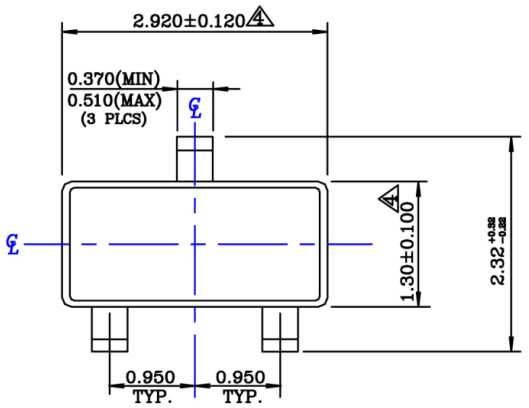
Top View
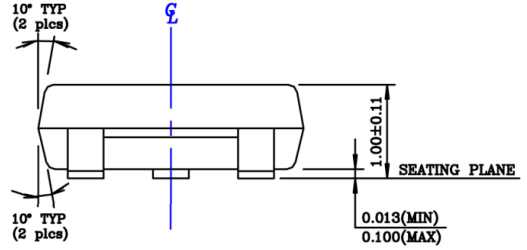
Side View
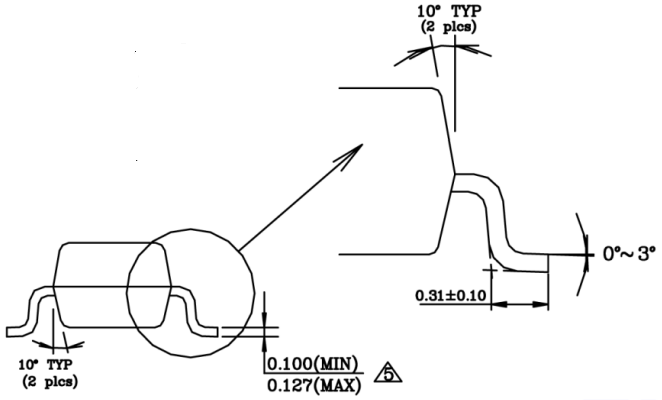
End View
MIC803 Recommended Land Pattern
The following is the Recommended Land Pattern of MIC803.
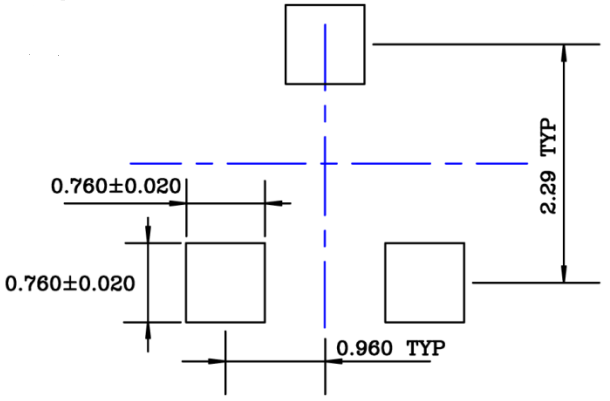
Recommended Land Pattern
MIC803 Manufacturer
Microchip Technology Inc. is a leading provider of microcontroller and analog semiconductors, providing low-risk product development, lower total system cost and faster time to market for thousands of diverse customer applications worldwide. Headquartered in Chandler, Arizona, Microchip offers outstanding technical support along with dependable delivery and quality.
Datasheet PDF
- PCN Assembly/Origin :
- Datasheets :
- PCN Packaging :
- ConflictMineralStatement :
What is the essential property of the MIC803?
The MIC803 is a single-voltage supervisor with open-drain reset output that provides accurate power supply monitoring and reset generation in microprocessor-based systems.
What is the function of the MIC803 device?
The function of the device is to assert a reset signal if the power supply voltage drops below the reset threshold voltage, and retain this reset for the reset timeout period once the power supply increases above the reset threshold voltage.
How many μA of supply current does the MIC803 consume?
The MIC803 consumes only 4.5μA of supply current and offers three reset delay periods of 20ms, 140ms, and 1120ms (minimum).
 Microchip PIC32MX130F064DVPT Technical Datasheet
29 February 2024215
 ATMEGA168 Microcontrollers: Features, Pinout, and Datasheet
07 December 20219720
 A Comprehensive Guide to LTC6906HS6#TRMPBF Programmable Timer and Oscillator
06 March 2024288
 AD620 Instrumentation Amplifier Design Guide
19 January 20261666
 BF199 NPN Silicon Transistor, BF199 Datasheet and Equivalents
30 March 20226481
![HT7333 How to use a HT7333 IC?[Video]](https://res.utmel.com/Images/Article/882d6c87-9c81-4515-b682-29cdfa70cf1a.png) HT7333 How to use a HT7333 IC?[Video]
HT7333 How to use a HT7333 IC?[Video]18 April 20227367
 ZiLOG ZLP12840 OTP MCU: Product Overview
29 February 2024305
 AT90CAN12815MT: Technical Product Analysis
29 February 2024237
 Utmel Christmas and New Year Carnival
07 December 20204242
 Introduction to Photonic Integrated Circuits and PIC Technology
22 October 202515660
 US Set to Close Loopholes in AI Chip Export Restrictions to China
23 October 20232263
 What is Inertial Measurement Unit (IMU)?
15 October 202511045
 What is Field Programmable Gate Array?
29 September 20204285
 Comparison of Advantages and Disadvantages of Common Switch Mode Power Supply(SMPS)
21 January 20228604
 Sensor Basics: Classification, Working Principle and Application
02 April 202530150
 What is Smoke Detector?
26 October 20214030
Microchip Technology
In Stock: 6000
United States
China
Canada
Japan
Russia
Germany
United Kingdom
Singapore
Italy
Hong Kong(China)
Taiwan(China)
France
Korea
Mexico
Netherlands
Malaysia
Austria
Spain
Switzerland
Poland
Thailand
Vietnam
India
United Arab Emirates
Afghanistan
Åland Islands
Albania
Algeria
American Samoa
Andorra
Angola
Anguilla
Antigua & Barbuda
Argentina
Armenia
Aruba
Australia
Azerbaijan
Bahamas
Bahrain
Bangladesh
Barbados
Belarus
Belgium
Belize
Benin
Bermuda
Bhutan
Bolivia
Bonaire, Sint Eustatius and Saba
Bosnia & Herzegovina
Botswana
Brazil
British Indian Ocean Territory
British Virgin Islands
Brunei
Bulgaria
Burkina Faso
Burundi
Cabo Verde
Cambodia
Cameroon
Cayman Islands
Central African Republic
Chad
Chile
Christmas Island
Cocos (Keeling) Islands
Colombia
Comoros
Congo
Congo (DRC)
Cook Islands
Costa Rica
Côte d’Ivoire
Croatia
Cuba
Curaçao
Cyprus
Czechia
Denmark
Djibouti
Dominica
Dominican Republic
Ecuador
Egypt
El Salvador
Equatorial Guinea
Eritrea
Estonia
Eswatini
Ethiopia
Falkland Islands
Faroe Islands
Fiji
Finland
French Guiana
French Polynesia
Gabon
Gambia
Georgia
Ghana
Gibraltar
Greece
Greenland
Grenada
Guadeloupe
Guam
Guatemala
Guernsey
Guinea
Guinea-Bissau
Guyana
Haiti
Honduras
Hungary
Iceland
Indonesia
Iran
Iraq
Ireland
Isle of Man
Israel
Jamaica
Jersey
Jordan
Kazakhstan
Kenya
Kiribati
Kosovo
Kuwait
Kyrgyzstan
Laos
Latvia
Lebanon
Lesotho
Liberia
Libya
Liechtenstein
Lithuania
Luxembourg
Macao(China)
Madagascar
Malawi
Maldives
Mali
Malta
Marshall Islands
Martinique
Mauritania
Mauritius
Mayotte
Micronesia
Moldova
Monaco
Mongolia
Montenegro
Montserrat
Morocco
Mozambique
Myanmar
Namibia
Nauru
Nepal
New Caledonia
New Zealand
Nicaragua
Niger
Nigeria
Niue
Norfolk Island
North Korea
North Macedonia
Northern Mariana Islands
Norway
Oman
Pakistan
Palau
Palestinian Authority
Panama
Papua New Guinea
Paraguay
Peru
Philippines
Pitcairn Islands
Portugal
Puerto Rico
Qatar
Réunion
Romania
Rwanda
Samoa
San Marino
São Tomé & Príncipe
Saudi Arabia
Senegal
Serbia
Seychelles
Sierra Leone
Sint Maarten
Slovakia
Slovenia
Solomon Islands
Somalia
South Africa
South Sudan
Sri Lanka
St Helena, Ascension, Tristan da Cunha
St. Barthélemy
St. Kitts & Nevis
St. Lucia
St. Martin
St. Pierre & Miquelon
St. Vincent & Grenadines
Sudan
Suriname
Svalbard & Jan Mayen
Sweden
Syria
Tajikistan
Tanzania
Timor-Leste
Togo
Tokelau
Tonga
Trinidad & Tobago
Tunisia
Turkey
Turkmenistan
Turks & Caicos Islands
Tuvalu
U.S. Outlying Islands
U.S. Virgin Islands
Uganda
Ukraine
Uruguay
Uzbekistan
Vanuatu
Vatican City
Venezuela
Wallis & Futuna
Yemen
Zambia
Zimbabwe
![MCP111T-300E/TT]() MCP111T-300E/TT
MCP111T-300E/TTMicrochip Technology
![MCP130T-300I/TT]() MCP130T-300I/TT
MCP130T-300I/TTMicrochip Technology
![MIC811SUY-TR]() MIC811SUY-TR
MIC811SUY-TRMicrochip Technology
![MCP100T-450I/TT]() MCP100T-450I/TT
MCP100T-450I/TTMicrochip Technology
![MCP120T-315I/TT]() MCP120T-315I/TT
MCP120T-315I/TTMicrochip Technology
![MCP111T-270E/TT]() MCP111T-270E/TT
MCP111T-270E/TTMicrochip Technology
![MCP120T-450I/TT]() MCP120T-450I/TT
MCP120T-450I/TTMicrochip Technology
![MCP120T-300I/TT]() MCP120T-300I/TT
MCP120T-300I/TTMicrochip Technology
![MCP120T-270I/TT]() MCP120T-270I/TT
MCP120T-270I/TTMicrochip Technology
![MCP130T-270I/TT]() MCP130T-270I/TT
MCP130T-270I/TTMicrochip Technology

