Product
 Brand
Brand Articles
 Tools
Tools
How to use BME280 with Arduino?


Pressure, Temperature and Humidity Sensor Digital Output 1.8V 8-Pin LGA T/R
This article provides you with a basic overview of the BME280 sensor, including its pin descriptions, functions and specifications, equivalents, etc., to help you quickly understand what BME280 is.

How to use BME280 Temperature, Humidity and Pressure sensor with Arduino
BME280 Description
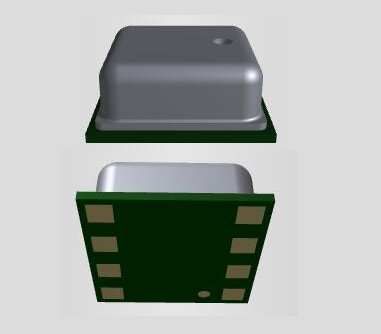
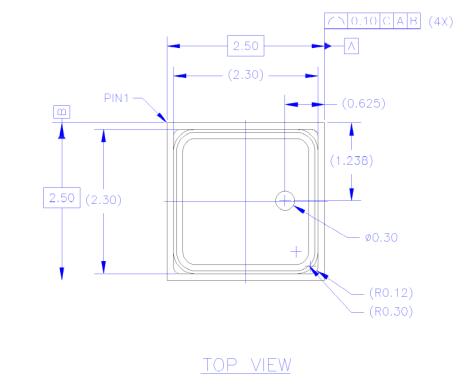
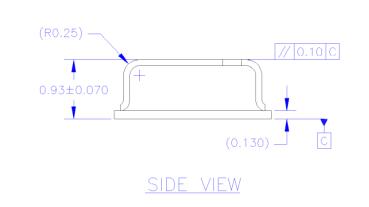
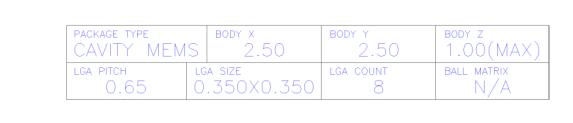
The BME280 is a combined digital humidity, pressure, and temperature sensor based on proven sensing principles. The sensor module is housed in an extremely compact metal-lid LGA package with a footprint of only 2.5 × 2.5 mm² with a height of 0.93 mm. Its small dimensions and its low power consumption allow the implementation in battery-driven devices such as handsets, GPS modules, or watches. The BME280 is registered and performance compatible with the Bosch Sensortec BMP280 digital pressure sensor.
The BME280 achieves high performance in all applications requiring humidity and pressure measurement. These emerging applications of home automation control, in-door navigation, fitness as well as GPS refinement require high accuracy and a low TCO at the same time.
The humidity sensor provides an extremely fast response time for fast context awareness applications and high overall accuracy over a wide temperature range.
The pressure sensor is an absolute barometric pressure sensor with extremely high accuracy and resolution and drastically lower noise than the Bosch Sensortec BMP180.
The integrated temperature sensor has been optimized for the lowest noise and highest resolution. Its output is used for temperature compensation of the pressure and humidity sensors and can also be used for the estimation of the ambient temperature.
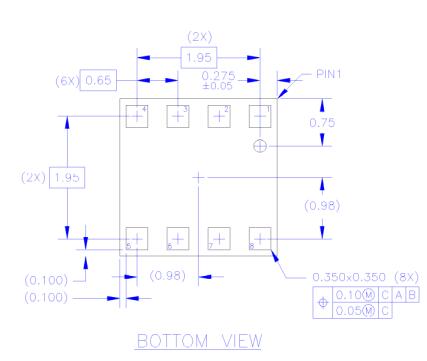
BME280 Pinout and Configuration
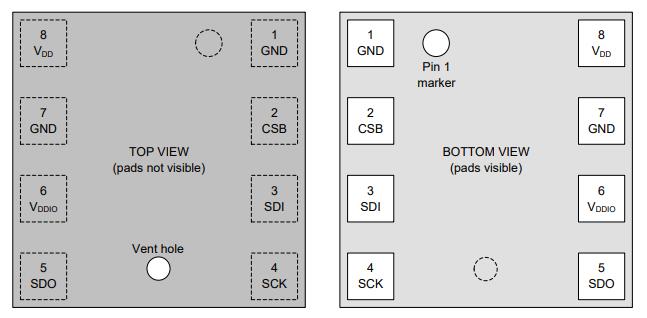
| Pin Number | Pin Name | Pin Description |
| 1 | GND | Ground |
| 2 | CSB | Chip Select |
| 3 | SDI | Serial Data Interface |
| 4 | SCK | Serial Clock Interface |
| 5 | SDO | Serial Data Output |
| 6 | VDDIO | Digital/Interface Supply |
| 7 | GND | Ground |
| 8 | VDD | Analog Supply |
BME280 CAD Models
Symbol
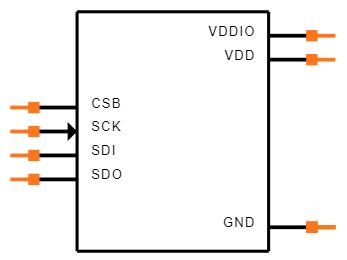
Footprint
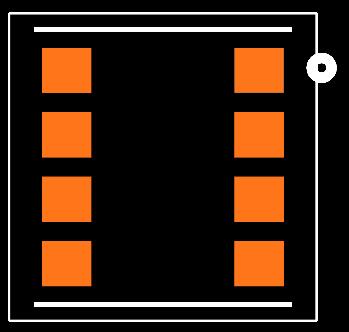
3D Models
BME280 Features
Built for Mobile Application and Comes in a 2.6mm x 2.5mm x 0.93mm metal lid LGA
Digital Interface I2C (up to 3.4 MHz) and SPI (3 and 4wire up to 10 MHz)
Main Supply Voltage Range: 1.71V to 3.6V
Interface Voltage Range: 1.2 V to 3.6 V
Current Consumption: 1.8uA @ 1Hz Humidity and Temperature
Operating Range: -40 to +85 C, Rel. Humidity: 0...100%, Pressure: 300...1100hPa
Register and performance compatible to Bosch Sensor Tec BMP280 pressure sensor
RoHS compliant, halogen-free, MSL1
The humidity sensor and pressure sensor can be independently enabled /disabled
Specifications
- TypeParameter
- Factory Lead Time14 Weeks
- Mounting Type
The "Mounting Type" in electronic components refers to the method used to attach or connect a component to a circuit board or other substrate, such as through-hole, surface-mount, or panel mount.
Surface Mount - Package / Case
refers to the protective housing that encases an electronic component, providing mechanical support, electrical connections, and thermal management.
8-VFLGA - Surface Mount
having leads that are designed to be soldered on the side of a circuit board that the body of the component is mounted on.
YES - Number of Pins8
- Operating Temperature
The operating temperature is the range of ambient temperature within which a power supply, or any other electrical equipment, operate in. This ranges from a minimum operating temperature, to a peak or maximum operating temperature, outside which, the power supply may fail.
-40°C~85°C - Packaging
Semiconductor package is a carrier / shell used to contain and cover one or more semiconductor components or integrated circuits. The material of the shell can be metal, plastic, glass or ceramic.
Tape & Reel (TR) - Published2015
- Part Status
Parts can have many statuses as they progress through the configuration, analysis, review, and approval stages.
Active - Moisture Sensitivity Level (MSL)
Moisture Sensitivity Level (MSL) is a standardized rating that indicates the susceptibility of electronic components, particularly semiconductors, to moisture-induced damage during storage and the soldering process, defining the allowable exposure time to ambient conditions before they require special handling or baking to prevent failures
1 (Unlimited) - Number of Terminations8
- Voltage - Supply
Voltage - Supply refers to the range of voltage levels that an electronic component or circuit is designed to operate with. It indicates the minimum and maximum supply voltage that can be applied for the device to function properly. Providing supply voltages outside this range can lead to malfunction, damage, or reduced performance. This parameter is critical for ensuring compatibility between different components in a circuit.
1.71V~3.6V - Terminal Position
In electronic components, the term "Terminal Position" refers to the physical location of the connection points on the component where external electrical connections can be made. These connection points, known as terminals, are typically used to attach wires, leads, or other components to the main body of the electronic component. The terminal position is important for ensuring proper connectivity and functionality of the component within a circuit. It is often specified in technical datasheets or component specifications to help designers and engineers understand how to properly integrate the component into their circuit designs.
BOTTOM - Terminal Form
Occurring at or forming the end of a series, succession, or the like; closing; concluding.
NO LEAD - Peak Reflow Temperature (Cel)
Peak Reflow Temperature (Cel) is a parameter that specifies the maximum temperature at which an electronic component can be exposed during the reflow soldering process. Reflow soldering is a common method used to attach electronic components to a circuit board. The Peak Reflow Temperature is crucial because it ensures that the component is not damaged or degraded during the soldering process. Exceeding the specified Peak Reflow Temperature can lead to issues such as component failure, reduced performance, or even permanent damage to the component. It is important for manufacturers and assemblers to adhere to the recommended Peak Reflow Temperature to ensure the reliability and functionality of the electronic components.
NOT SPECIFIED - Number of Functions1
- Time@Peak Reflow Temperature-Max (s)
Time@Peak Reflow Temperature-Max (s) refers to the maximum duration that an electronic component can be exposed to the peak reflow temperature during the soldering process, which is crucial for ensuring reliable solder joint formation without damaging the component.
NOT SPECIFIED - Output
In electronic components, the parameter "Output" typically refers to the signal or data that is produced by the component and sent to another part of the circuit or system. The output can be in the form of voltage, current, frequency, or any other measurable quantity depending on the specific component. The output of a component is often crucial in determining its functionality and how it interacts with other components in the circuit. Understanding the output characteristics of electronic components is essential for designing and troubleshooting electronic circuits effectively.
16b - Output Type
The "Output Type" parameter in electronic components refers to the type of signal or data that is produced by the component as an output. This parameter specifies the nature of the output signal, such as analog or digital, and can also include details about the voltage levels, current levels, frequency, and other characteristics of the output signal. Understanding the output type of a component is crucial for ensuring compatibility with other components in a circuit or system, as well as for determining how the output signal can be utilized or processed further. In summary, the output type parameter provides essential information about the nature of the signal that is generated by the electronic component as its output.
I2C, SPI - Supply Voltage-Max (Vsup)
The parameter "Supply Voltage-Max (Vsup)" in electronic components refers to the maximum voltage that can be safely applied to the component without causing damage. It is an important specification to consider when designing or using electronic circuits to ensure the component operates within its safe operating limits. Exceeding the maximum supply voltage can lead to overheating, component failure, or even permanent damage. It is crucial to adhere to the specified maximum supply voltage to ensure the reliable and safe operation of the electronic component.
3.6V - Supply Voltage-Min (Vsup)
The parameter "Supply Voltage-Min (Vsup)" in electronic components refers to the minimum voltage level required for the component to operate within its specified performance range. This parameter indicates the lowest voltage that can be safely applied to the component without risking damage or malfunction. It is crucial to ensure that the supply voltage provided to the component meets or exceeds this minimum value to ensure proper functionality and reliability. Failure to adhere to the specified minimum supply voltage may result in erratic behavior, reduced performance, or even permanent damage to the component.
1.71V - Analog IC - Other Type
Analog IC - Other Type is a parameter used to categorize electronic components that are integrated circuits (ICs) designed for analog signal processing but do not fall into more specific subcategories such as amplifiers, comparators, or voltage regulators. These ICs may include specialized analog functions such as analog-to-digital converters (ADCs), digital-to-analog converters (DACs), voltage references, or signal conditioning circuits. They are typically used in various applications where precise analog signal processing is required, such as in audio equipment, instrumentation, communication systems, and industrial control systems. Manufacturers provide detailed specifications for these components to help engineers select the most suitable IC for their specific design requirements.
ANALOG CIRCUIT - Accuracy
Accuracy in electronic components refers to the degree to which a measured value agrees with the true or accepted value. It evaluates the precision of a component in providing correct output or measurement under specified conditions. High accuracy indicates minimal deviation from the actual value, while low accuracy shows significant error in measurement. This parameter is crucial in applications where precise data is essential for reliable performance and decision-making.
±3% - Response Time
the time taken for a circuit or measuring device, when subjected to a change in input signal, to change its state by a specified fraction of its total response to that change.
1s - Sensor Type
In electronic components, the parameter "Sensor Type" refers to the specific type of sensor technology used in a particular component to detect and measure physical phenomena such as light, temperature, pressure, motion, or proximity. Different sensor types utilize various principles and mechanisms to convert the detected input into an electrical signal that can be processed by the electronic component. Common sensor types include photodiodes, thermistors, accelerometers, and proximity sensors, each designed for specific applications and environments. Understanding the sensor type is crucial for selecting the right component for a given task and ensuring accurate and reliable sensing capabilities in electronic systems.
Humidity, Pressure, Temperature - Humidity Range
Humidity is a measure of the amount of water vapor in the air. Relative humidity measures the amount of water in the air in relation to the maximum amount of water vapor (moisture).
0 ~ 100% RH - RoHS Status
RoHS means “Restriction of Certain Hazardous Substances” in the “Hazardous Substances Directive” in electrical and electronic equipment.
ROHS3 Compliant - Lead Free
Lead Free is a term used to describe electronic components that do not contain lead as part of their composition. Lead is a toxic material that can have harmful effects on human health and the environment, so the electronics industry has been moving towards lead-free components to reduce these risks. Lead-free components are typically made using alternative materials such as silver, copper, and tin. Manufacturers must comply with regulations such as the Restriction of Hazardous Substances (RoHS) directive to ensure that their products are lead-free and environmentally friendly.
Lead Free
BME280 Applications
Context awareness, e.g. skin detection, room change detection
Fitness monitoring/well-being
Measurement of volume and airflow
Home automation control
control heating, venting, and air conditioning (HVAC)
Internet of things
GPS enhancement (time-to-first-fix improvement, dead reckoning, slope detection)
Indoor navigation (change of floor detection, elevator detection)
Outdoor navigation, leisure, and sports applications
Weather forecast
Vertical velocity indicator (rise/sink speed)
BME280 Equivalents
BME180, BMP280, HTU21D
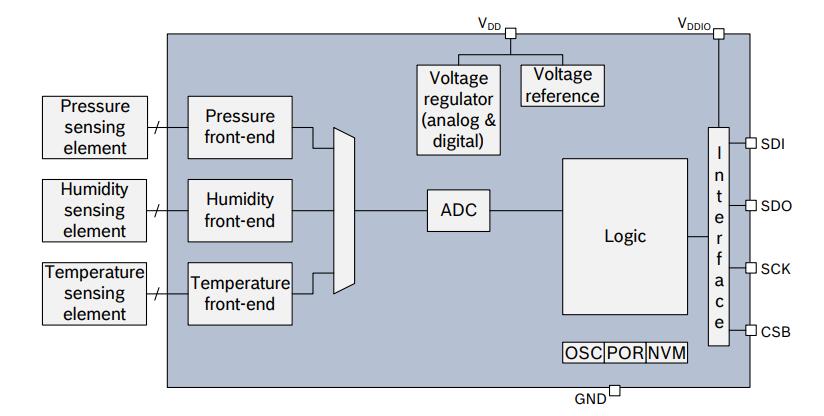
BME280 Block Diagram
BME280 Manufacturer
Bosch Sensortec GmbH, a fully owned subsidiary of Robert Bosch GmbH, develops and markets a wide portfolio of microelectromechanical systems (MEMS) sensors and solutions tailored for smartphones, tablets, wearables and hearables, AR/VR devices, drones, robots, smart home, and IoT (Internet of Things) applications.
How to use BME280
Because the BME280 sensor operates between 1.7 and 3.3 volts, it can be driven with 3.3-volt logic levels. Because it lacks a voltage regulator, 5V operations must be performed using a voltage regulator and level shifters. It is normally advised that it be operated at 3.3V and no higher than 3.6VDC.
The BME280 module only supports I2C and SPI interfaces and has an I2C address of 0x76 by default. The BMP280's Chip Select (CSB) and Serial Data Output (SDO) pins are only required when SPI-based (four-wire) communication is used. I2C is a two-wire interface that includes SDA and SCK. To change the I2C address to 0x76, unplug module pin 6 (SDO) — the onboard resistor pulls the SDO pin low, setting the address to 0x76. Connect pin 6 of the module (SDO) to Vcc, which is normally the 3.3V supply, to alter the I2C address to 0x77. To select the I2C interface, connect Pin 5 of the module (CSB) to Vcc. Because an integrated pull-up resistor already does this, Pin 5 can be left unplugged while using the I2C interface. The I2C and SPI configuration connection diagram is presented below.

BME280 Package
BME280 vs BMP180
The BME280 and BMP180 are barometric sensors which means they read atmospheric pressure. The BME280 is also equipped with a temperature and a humidity sensor, and the BMP180 with a temperature sensor. Because pressure changes with altitude, these sensors can also be used to estimate altitude.
When it comes to temperature range, the BME280 has a wider measurement range: -40 to 85ºC, while the BMP180 just measures from 0 to 65ºC. You should keep in mind that the BME280 module self-heats a little bit, so the temperature measurements maybe 1 or 2 degrees above the real temperature value.
The BME280 can use either I2C or SPI communication protocol while the BMP180 can only use I2C communication.
The BME280 sensor is more expensive but it has more functionalities. For example, you can build a weather station project with only this sensor. But if you’re not interested in measuring the pressure or humidity, you can get a cheaper temperature sensor.
Trend Analysis
Datasheet PDF
- Datasheets :
- Environmental Information :
Parts with Similar Specs
- ImagePart NumberManufacturerPackage / CaseNumber of PinsAccuracyRoHS StatusSurface MountMoisture Sensitivity Level (MSL)Port StyleApplicationsView Compare
![BME280]()
BME280
8-VFLGA
8
±3%
ROHS3 Compliant
YES
1 (Unlimited)
-
-
![MPL3115A2R1]()
8-TLGA
-
±0.058PSI (±0.4kPa)
ROHS3 Compliant
YES
1 (Unlimited)
No Port
Board Mount
![MPL115A2T1]()
8-TLGA
-
±0.145PSI (±1kPa)
ROHS3 Compliant
YES
1 (Unlimited)
No Port
Board Mount
![MPL3115A2]()
8-TLGA
-
±0.145PSI (±1kPa)
ROHS3 Compliant
YES
1 (Unlimited)
No Port
Board Mount
![MPL115A1T1]()
8-TLGA
-
±0.058PSI (±0.4kPa)
ROHS3 Compliant
YES
1 (Unlimited)
No Port
Board Mount


What is BME 280?
The BME280 is a humidity sensor designed specifically for mobile applications and wearables where small size and low battery consumption are important design characteristics. The unit combines high linearity and high accuracy sensors, making it ideal for low current consumption, long-term stability, and EMC resilience.
How does a humidity sensor work?
A capacitive humidity sensor measures relative humidity by placing a thin strip of metal oxide between two electrodes.
How does the BME280 measure pressure?
The BME280 sensor module reads barometric pressure, temperature, and humidity. Because pressure changes with altitude, you can also estimate altitude. There are several versions of this sensor module. The BME280 sensor uses I2C or SPI communication protocol to exchange data with a microcontroller.
Where should I put my humidity sensor?
The mounting location should be in a sheltered area that is protected from rain. Ideally, the transmitter should be located on the north side of the building (under an eave) to prevent sun-heated air from rising up the building's wall and affecting the relative humidity of the sensor.
Why do we need humidity sensor?
Humidity sensors are electronic devices that measure and report the moisture and air temperature of the surrounding environment where they are deployed e.g., in air, soil, or confined spaces. Humidity measurements indicate the concentration of water vapor present in the air.
 LM317K 1.2V TO 37V VOLTAGE REGULATOR:Pinout, Datasheet, and Applications
14 September 20213120
 SN74HC08N AND gate: Pinout, Applications and Datasheet
17 October 20235897
![USB3300 Transceiver: Features, Pinout, and Datasheet [Video&FAQ]](https://res.utmel.com/Images/Article/78581097-7876-47e6-831f-4bda4f5f0eac.png) USB3300 Transceiver: Features, Pinout, and Datasheet [Video&FAQ]
USB3300 Transceiver: Features, Pinout, and Datasheet [Video&FAQ]05 May 20226842
 MSP430F20x1, MSP430F20x2, and MSP430F20x3: Mixed-Signal Microcontroller
29 February 2024222
 AP7331 Linear Regulator: Features, Pinout and Datasheet
11 March 20221086
 TSOP4838: Description, datasheet, and features
15 March 20224919
 How to use ATTINY85 Microcontroller?
08 April 20224083
 DS1820 Digital Thermometer: Pinout, Datasheet and Comparison
04 August 20216818
 Will HBM replace DDR and become Computer Memory?
09 September 202128457
 The Introduction of Oscilloscope Probes
11 January 20228267
 MLCC Substitution Guide: What to Do When Your Capacitor Is on a 30-Week Lead Time
31 July 2026756
 L298N: A Motor Driver That Accepts High Voltages
24 February 20234702
 What is Metaverse?
09 October 20212945
 Will MicroLED replace LCD and OLED?
31 August 20213910
 NPN Transistors and PNP Transistors
29 October 202010151
 FPGA vs SoC: A Comprehensive Comparison Guide
13 May 20256222
Bosch Sensortec
In Stock: 1521
United States
China
Canada
Japan
Russia
Germany
United Kingdom
Singapore
Italy
Hong Kong(China)
Taiwan(China)
France
Korea
Mexico
Netherlands
Malaysia
Austria
Spain
Switzerland
Poland
Thailand
Vietnam
India
United Arab Emirates
Afghanistan
Åland Islands
Albania
Algeria
American Samoa
Andorra
Angola
Anguilla
Antigua & Barbuda
Argentina
Armenia
Aruba
Australia
Azerbaijan
Bahamas
Bahrain
Bangladesh
Barbados
Belarus
Belgium
Belize
Benin
Bermuda
Bhutan
Bolivia
Bonaire, Sint Eustatius and Saba
Bosnia & Herzegovina
Botswana
Brazil
British Indian Ocean Territory
British Virgin Islands
Brunei
Bulgaria
Burkina Faso
Burundi
Cabo Verde
Cambodia
Cameroon
Cayman Islands
Central African Republic
Chad
Chile
Christmas Island
Cocos (Keeling) Islands
Colombia
Comoros
Congo
Congo (DRC)
Cook Islands
Costa Rica
Côte d’Ivoire
Croatia
Cuba
Curaçao
Cyprus
Czechia
Denmark
Djibouti
Dominica
Dominican Republic
Ecuador
Egypt
El Salvador
Equatorial Guinea
Eritrea
Estonia
Eswatini
Ethiopia
Falkland Islands
Faroe Islands
Fiji
Finland
French Guiana
French Polynesia
Gabon
Gambia
Georgia
Ghana
Gibraltar
Greece
Greenland
Grenada
Guadeloupe
Guam
Guatemala
Guernsey
Guinea
Guinea-Bissau
Guyana
Haiti
Honduras
Hungary
Iceland
Indonesia
Iran
Iraq
Ireland
Isle of Man
Israel
Jamaica
Jersey
Jordan
Kazakhstan
Kenya
Kiribati
Kosovo
Kuwait
Kyrgyzstan
Laos
Latvia
Lebanon
Lesotho
Liberia
Libya
Liechtenstein
Lithuania
Luxembourg
Macao(China)
Madagascar
Malawi
Maldives
Mali
Malta
Marshall Islands
Martinique
Mauritania
Mauritius
Mayotte
Micronesia
Moldova
Monaco
Mongolia
Montenegro
Montserrat
Morocco
Mozambique
Myanmar
Namibia
Nauru
Nepal
New Caledonia
New Zealand
Nicaragua
Niger
Nigeria
Niue
Norfolk Island
North Korea
North Macedonia
Northern Mariana Islands
Norway
Oman
Pakistan
Palau
Palestinian Authority
Panama
Papua New Guinea
Paraguay
Peru
Philippines
Pitcairn Islands
Portugal
Puerto Rico
Qatar
Réunion
Romania
Rwanda
Samoa
San Marino
São Tomé & Príncipe
Saudi Arabia
Senegal
Serbia
Seychelles
Sierra Leone
Sint Maarten
Slovakia
Slovenia
Solomon Islands
Somalia
South Africa
South Sudan
Sri Lanka
St Helena, Ascension, Tristan da Cunha
St. Barthélemy
St. Kitts & Nevis
St. Lucia
St. Martin
St. Pierre & Miquelon
St. Vincent & Grenadines
Sudan
Suriname
Svalbard & Jan Mayen
Sweden
Syria
Tajikistan
Tanzania
Timor-Leste
Togo
Tokelau
Tonga
Trinidad & Tobago
Tunisia
Turkey
Turkmenistan
Turks & Caicos Islands
Tuvalu
U.S. Outlying Islands
U.S. Virgin Islands
Uganda
Ukraine
Uruguay
Uzbekistan
Vanuatu
Vatican City
Venezuela
Wallis & Futuna
Yemen
Zambia
Zimbabwe