

 Product
 Brand
Brand Articles
 Tools
Tools
MPR121 Capacitive Touch Sensor Module: How to use the MPR121?


0.4mm Capacitive Sensor 3.3V 20-UFQFN
MPR121 is a capacitive touch sensor module. So this article is going to introduce pinout, applications, features, and more details about MPR121.
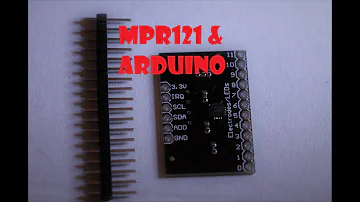
MPR121 turn (almost) any surface to a touch button for arduino
MPR121 Description
Push buttons for inputs may not be viable in some projects. The limitations could be spatial or connected to the cost of parts. In these situations, a capacitive touch sensor IC can convert an exposed PCB surface into a touch-activated push-button. This function is performed by the MR121 module, which has 12 input channels.
MPR121 Features
1.7V to 3.6V supply voltage and 29uA supply current
12 capacitive sensing inputs
8 LED/GPIO pins
MPR121 Pinout

MPR121 Pinout
MPR121 Pin Description
| Pin Name | Description |
| 3.3V | Power supply input pin, nominally 3.3V |
| IRQ | Open-drain interrupt output |
| SCL | I2C Serial Clock |
| SDA | I2C Serial Data |
| ADD | I2C Address Selector |
| GND | IC Ground Reference |
| 0 - 11 | Inputs for capacitive sensors/LED outputs |
MPR121 Dimension
 MPR121 Dimension
Specifications
- TypeParameter
- Mounting Type
The "Mounting Type" in electronic components refers to the method used to attach or connect a component to a circuit board or other substrate, such as through-hole, surface-mount, or panel mount.
Surface Mount - Package / Case
refers to the protective housing that encases an electronic component, providing mechanical support, electrical connections, and thermal management.
20-UFQFN - Surface Mount
having leads that are designed to be soldered on the side of a circuit board that the body of the component is mounted on.
YES - Operating Temperature
The operating temperature is the range of ambient temperature within which a power supply, or any other electrical equipment, operate in. This ranges from a minimum operating temperature, to a peak or maximum operating temperature, outside which, the power supply may fail.
-40°C~85°C - Packaging
Semiconductor package is a carrier / shell used to contain and cover one or more semiconductor components or integrated circuits. The material of the shell can be metal, plastic, glass or ceramic.
Tape & Reel (TR) - Published2003
- Part Status
Parts can have many statuses as they progress through the configuration, analysis, review, and approval stages.
Discontinued - Moisture Sensitivity Level (MSL)
Moisture Sensitivity Level (MSL) is a standardized rating that indicates the susceptibility of electronic components, particularly semiconductors, to moisture-induced damage during storage and the soldering process, defining the allowable exposure time to ambient conditions before they require special handling or baking to prevent failures
3 (168 Hours) - Number of Terminations20
- TypeButtons, Slider, Wheel
- HTS Code
HTS (Harmonized Tariff Schedule) codes are product classification codes between 8-1 digits. The first six digits are an HS code, and the countries of import assign the subsequent digits to provide additional classification. U.S. HTS codes are 1 digits and are administered by the U.S. International Trade Commission.
8542.39.00.01 - Voltage - Supply
Voltage - Supply refers to the range of voltage levels that an electronic component or circuit is designed to operate with. It indicates the minimum and maximum supply voltage that can be applied for the device to function properly. Providing supply voltages outside this range can lead to malfunction, damage, or reduced performance. This parameter is critical for ensuring compatibility between different components in a circuit.
2V~3.6V - Terminal Position
In electronic components, the term "Terminal Position" refers to the physical location of the connection points on the component where external electrical connections can be made. These connection points, known as terminals, are typically used to attach wires, leads, or other components to the main body of the electronic component. The terminal position is important for ensuring proper connectivity and functionality of the component within a circuit. It is often specified in technical datasheets or component specifications to help designers and engineers understand how to properly integrate the component into their circuit designs.
QUAD - Terminal Form
Occurring at or forming the end of a series, succession, or the like; closing; concluding.
NO LEAD - Number of Functions1
- Supply Voltage
Supply voltage refers to the electrical potential difference provided to an electronic component or circuit. It is crucial for the proper operation of devices, as it powers their functions and determines performance characteristics. The supply voltage must be within specified limits to ensure reliability and prevent damage to components. Different electronic devices have specific supply voltage requirements, which can vary widely depending on their design and intended application.
3.3V - Terminal Pitch
The center distance from one pole to the next.
0.4mm - JESD-30 Code
JESD-30 Code refers to a standardized descriptive designation system established by JEDEC for semiconductor-device packages. This system provides a systematic method for generating designators that convey essential information about the package's physical characteristics, such as size and shape, which aids in component identification and selection. By using JESD-30 codes, manufacturers and engineers can ensure consistency and clarity in the specification of semiconductor packages across various applications and industries.
S-XQCC-N20 - Supply Voltage-Max (Vsup)
The parameter "Supply Voltage-Max (Vsup)" in electronic components refers to the maximum voltage that can be safely applied to the component without causing damage. It is an important specification to consider when designing or using electronic circuits to ensure the component operates within its safe operating limits. Exceeding the maximum supply voltage can lead to overheating, component failure, or even permanent damage. It is crucial to adhere to the specified maximum supply voltage to ensure the reliable and safe operation of the electronic component.
3.6V - Supply Voltage-Min (Vsup)
The parameter "Supply Voltage-Min (Vsup)" in electronic components refers to the minimum voltage level required for the component to operate within its specified performance range. This parameter indicates the lowest voltage that can be safely applied to the component without risking damage or malfunction. It is crucial to ensure that the supply voltage provided to the component meets or exceeds this minimum value to ensure proper functionality and reliability. Failure to adhere to the specified minimum supply voltage may result in erratic behavior, reduced performance, or even permanent damage to the component.
2V - Interface
In electronic components, the term "Interface" refers to the point at which two different systems, devices, or components connect and interact with each other. It can involve physical connections such as ports, connectors, or cables, as well as communication protocols and standards that facilitate the exchange of data or signals between the connected entities. The interface serves as a bridge that enables seamless communication and interoperability between different parts of a system or between different systems altogether. Designing a reliable and efficient interface is crucial in ensuring proper functionality and performance of electronic components and systems.
I2C - Current - Supply
Current - Supply is a parameter in electronic components that refers to the maximum amount of electrical current that the component can provide to the circuit it is connected to. It is typically measured in units of amperes (A) and is crucial for determining the power handling capability of the component. Understanding the current supply rating is important for ensuring that the component can safely deliver the required current without overheating or failing. It is essential to consider this parameter when designing circuits to prevent damage to the component and ensure proper functionality of the overall system.
393μA - Number of InputsUp to 12
- Proximity Detection
A proximity sensor is a non-contact sensor that detects the presence of an object (often referred to as the “target”) when the target enters the sensor’s field. Depending on the type of proximity sensor, sound, light, infrared radiation (IR), or electromagnetic fields may be utilized by the sensor to detect a target.
Yes - LED Driver Channels
LED Driver Channels refer to the number of individual channels or outputs that a LED driver can control. Each channel typically corresponds to a single LED or a group of LEDs that can be independently controlled for brightness, color, or other parameters. The more channels a LED driver has, the more flexibility it offers in terms of creating dynamic lighting effects or controlling multiple LEDs separately. LED Driver Channels are an important specification to consider when designing lighting systems that require precise control over individual LEDs or groups of LEDs.
Up to 8 - Length3mm
- Height Seated (Max)
Height Seated (Max) is a parameter in electronic components that refers to the maximum allowable height of the component when it is properly seated or installed on a circuit board or within an enclosure. This specification is crucial for ensuring proper fit and alignment within the overall system design. Exceeding the maximum seated height can lead to mechanical interference, electrical shorts, or other issues that may impact the performance and reliability of the electronic device. Manufacturers provide this information to help designers and engineers select components that will fit within the designated space and function correctly in the intended application.
0.6mm - Width3mm
- RoHS Status
RoHS means “Restriction of Certain Hazardous Substances” in the “Hazardous Substances Directive” in electrical and electronic equipment.
ROHS3 Compliant
MPR121 Applications
Computer peripherals
MP3 players
Remote controls
Lighting controls
How To Use Capacitive Touch Sensor Module
A capacitor is a type of electrical component that temporarily stores charge. Its ability to grow voltage linearly when a constant current is provided to it, or exponentially when coupled to a constant voltage through a resistor, is particularly helpful. This is a highly typical characteristic in timing applications. The time constant of the circuit varies if one end of this capacitor is connected to this circuit and the other end is left floating or created by a floating body. A capacitive touch sensor works on this principle: one end is connected to an IC that generates a signal using the time constant, and the other end is created by the finger touching the "contact."
The MPR121 is an integrated circuit that contains all of the circuits required to construct twelve capacitive touch sensors. Electrodes, which are just metallic pads, can be connected to the twelve pins. Eight of these pins can alternatively be used as GPIOs or LED driver outputs. To communicate with the IC, the I2C protocol is employed. The ADD pin can be connected to GND, VCC, SCL, or SDA to select one of four distinct addresses.
MPR121 Manufacturer
NXP Semiconductors advances solutions that make life easier, better, and safer by enabling secure connectivity and infrastructure for a smarter world. NXP is driving innovation in the secure connected car, end-to-end security & privacy, and smart connected solutions industries as the world leader in secure connectivity solutions for embedded applications. The organization has 45,000 employees in over 35 countries and is based on more than 60 years of combined experience and expertise. NXP Semiconductor has bought Freescale Semiconductor.
Datasheet PDF
- PCN Packaging :
- Environmental Information :
Popularity by Region
What is the MPR121 Capacitive Touch Sensor Module?
A capacitive touch sensor IC can convert an exposed PCB surface into a touch-activated push-button. This function is performed by the MR121 module, which has 12 input channels.
What can the MPR121 be used for?
It can be applied to Computer peripherals, MP3 players, Remote controls, and Lighting Controls.
What’s the operating temperature of MPR121?
-40°C~85°C.
 DS1693 RTC: Datasheet, Pinout, Features
31 August 2021674
 A Comprehensive Guide to LTC7821IUH#PBF DC-DC Switching Controller
06 March 2024285
![ADS1115 and ESP32 How to measure voltage?[Video]](https://res.utmel.com/Images/Article/c5ac35c4-d32f-4c4c-bd74-871fae51edb5.png) ADS1115 and ESP32 How to measure voltage?[Video]
ADS1115 and ESP32 How to measure voltage?[Video]15 April 202211998
 Unveiling the Microchip PIC32MX1XX/2XX 32-bit Microcontrollers: A Technical Investigation
29 February 2024263
![KSZ8081MNXCA 10BASE-T/100BASE-TX Physical Layer Transceiver[FAQ]: Datasheet, Features, and Pinout](https://res.utmel.com/Images/Article/0e97f563-2d35-4876-a8e2-c19212086fdd.jpg) KSZ8081MNXCA 10BASE-T/100BASE-TX Physical Layer Transceiver[FAQ]: Datasheet, Features, and Pinout
KSZ8081MNXCA 10BASE-T/100BASE-TX Physical Layer Transceiver[FAQ]: Datasheet, Features, and Pinout22 March 2022463
 BC107 Transistor: Pinout, Equivalent and Datasheet
17 September 202130286
 74HC00 Quadruple 2-Input NAND Gates: 74LS Series vs. 74HC Series
11 November 20217699
 8 Bit vs. 32 Bit: Which Bit-size is the Superior Choise?
11 April 20226758
 The Energy Internet - A New Era of Energy Management and Distribution
11 July 20235832
 State-of-Charge Estimation Techniques for Lithium-Ion Batteries
26 January 20242746
 DIP Switch: Introduction and Classification
20 January 202117444
 Capacitor Networks Complete Guide: From Basic Calculations to Advanced Applications
18 August 20254836
 Using FPGAs for Real-Time Signal Processing: Key Considerations and Architectural Trade-Offs
26 August 2026285
 What is Graphics Processing Unit (GPU)?
18 October 20218454
 What are Graphene Transistors?
21 October 202510311
 LVDT - Linear Variable Differential Transformer Basics
16 January 20219640
NXP USA Inc.
In Stock
United States
China
Canada
Japan
Russia
Germany
United Kingdom
Singapore
Italy
Hong Kong(China)
Taiwan(China)
France
Korea
Mexico
Netherlands
Malaysia
Austria
Spain
Switzerland
Poland
Thailand
Vietnam
India
United Arab Emirates
Afghanistan
Åland Islands
Albania
Algeria
American Samoa
Andorra
Angola
Anguilla
Antigua & Barbuda
Argentina
Armenia
Aruba
Australia
Azerbaijan
Bahamas
Bahrain
Bangladesh
Barbados
Belarus
Belgium
Belize
Benin
Bermuda
Bhutan
Bolivia
Bonaire, Sint Eustatius and Saba
Bosnia & Herzegovina
Botswana
Brazil
British Indian Ocean Territory
British Virgin Islands
Brunei
Bulgaria
Burkina Faso
Burundi
Cabo Verde
Cambodia
Cameroon
Cayman Islands
Central African Republic
Chad
Chile
Christmas Island
Cocos (Keeling) Islands
Colombia
Comoros
Congo
Congo (DRC)
Cook Islands
Costa Rica
Côte d’Ivoire
Croatia
Cuba
Curaçao
Cyprus
Czechia
Denmark
Djibouti
Dominica
Dominican Republic
Ecuador
Egypt
El Salvador
Equatorial Guinea
Eritrea
Estonia
Eswatini
Ethiopia
Falkland Islands
Faroe Islands
Fiji
Finland
French Guiana
French Polynesia
Gabon
Gambia
Georgia
Ghana
Gibraltar
Greece
Greenland
Grenada
Guadeloupe
Guam
Guatemala
Guernsey
Guinea
Guinea-Bissau
Guyana
Haiti
Honduras
Hungary
Iceland
Indonesia
Iran
Iraq
Ireland
Isle of Man
Israel
Jamaica
Jersey
Jordan
Kazakhstan
Kenya
Kiribati
Kosovo
Kuwait
Kyrgyzstan
Laos
Latvia
Lebanon
Lesotho
Liberia
Libya
Liechtenstein
Lithuania
Luxembourg
Macao(China)
Madagascar
Malawi
Maldives
Mali
Malta
Marshall Islands
Martinique
Mauritania
Mauritius
Mayotte
Micronesia
Moldova
Monaco
Mongolia
Montenegro
Montserrat
Morocco
Mozambique
Myanmar
Namibia
Nauru
Nepal
New Caledonia
New Zealand
Nicaragua
Niger
Nigeria
Niue
Norfolk Island
North Korea
North Macedonia
Northern Mariana Islands
Norway
Oman
Pakistan
Palau
Palestinian Authority
Panama
Papua New Guinea
Paraguay
Peru
Philippines
Pitcairn Islands
Portugal
Puerto Rico
Qatar
Réunion
Romania
Rwanda
Samoa
San Marino
São Tomé & Príncipe
Saudi Arabia
Senegal
Serbia
Seychelles
Sierra Leone
Sint Maarten
Slovakia
Slovenia
Solomon Islands
Somalia
South Africa
South Sudan
Sri Lanka
St Helena, Ascension, Tristan da Cunha
St. Barthélemy
St. Kitts & Nevis
St. Lucia
St. Martin
St. Pierre & Miquelon
St. Vincent & Grenadines
Sudan
Suriname
Svalbard & Jan Mayen
Sweden
Syria
Tajikistan
Tanzania
Timor-Leste
Togo
Tokelau
Tonga
Trinidad & Tobago
Tunisia
Turkey
Turkmenistan
Turks & Caicos Islands
Tuvalu
U.S. Outlying Islands
U.S. Virgin Islands
Uganda
Ukraine
Uruguay
Uzbekistan
Vanuatu
Vatican City
Venezuela
Wallis & Futuna
Yemen
Zambia
Zimbabwe
![MPR031EPR2]() MPR031EPR2
MPR031EPR2NXP USA Inc.
![MPR084EJ]() MPR084EJ
MPR084EJNXP USA Inc.
![MPR083EJ]() MPR083EJ
MPR083EJNXP USA Inc.
![PCA8886TS/Q900/1,1]() PCA8886TS/Q900/1,1
PCA8886TS/Q900/1,1NXP USA Inc.
![MPR084Q]() MPR084Q
MPR084QNXP USA Inc.
![MPR083Q]() MPR083Q
MPR083QNXP USA Inc.
![PCF8883US/7EA/1Y]() PCF8883US/7EA/1Y
PCF8883US/7EA/1YNXP USA Inc.
![PCF8883T/1,118]() PCF8883T/1,118
PCF8883T/1,118NXP USA Inc.
![PCF8885TS/1,118]() PCF8885TS/1,118
PCF8885TS/1,118NXP USA Inc.


