

 Product
 Brand
Brand Articles
 Tools
Tools
RS232 VS DB9: Disadvantages and advantages of RS232 and DB9, Differences between the RS232 and DB9


SURGE SUPPRESSOR RS-232 DB9M/F
RS232 and DB9 are all data connectors. This article is going to talk about the advantages, disadvantages of RS232 and DB9, and introduce the differences between RS232 VS DB9.

RS 232 DB9 Connector by Prof.Sachin Sambhaji Patil
- What is RS232 Protocol?
- How RS232 Works?
- What is a DB9 Connector?
- Where are DB9 Connectors used?
- RS232 VS DB9 3D Model
- RS232 VS DB9 Features
- Advantages and Disadvantages of RS232
- Advantages and Disadvantages of DB9
- What is the difference between DB9 and RS232?
- DB9 Manufacturer
- RS232 and DB9 Datasheet
- Popularity by Region
What is RS232 Protocol?
In RS232, ‘RS’ stands for Recommended Standard. It defines serial communication using DTE and DCE signals. Here, DTE refers to Data Terminal Equipment and DCE refers to Data Communication Equipment. An example of a DTE device is a computer and DCE is a modem. Formally, it is specified as the interface between DTE equipment and DCE equipment using serial binary data exchange.
The DTE (computer) transmits the information serially to the other end equipment DCE (modem). In this case, DTE sends binary data “11011101” to DCE and DCE sends binary data “11010101” to the DTE device. RS232 describes the common voltage levels, electrical standards, operation mode, and a number of bits to be transferred from DTE to DCE. This standard is used for the transmission of information exchange over telephone lines.

How RS232 Works?
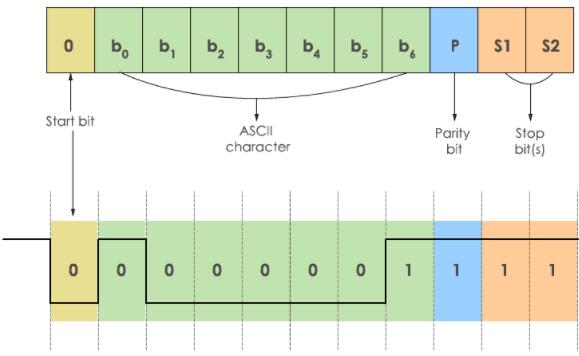
The working of RS-232 can be understood by the protocol format. As RS-232 is a point-to-point asynchronous communication protocol, it sends data in a single direction. Here, no clock is required for synchronizing the transmitter and receiver. The data format is initiated with a start bit followed by 7-bit binary data, parity bit, and stop bit which are sent one after another.
The transmission begins by sending a Start bit ‘0’. This is succeeded by 7 bits of ASCII data. The parity bit is appended to this data for the receiver validation. The data sent from the transmitter should match the receiver. Finally, the transmission is halted using a stop bit and it is represented by the binary ‘1’. Generally, 1 or 2 stop bits can be sent. In the above diagram, ASCII character ‘A’ is sent using a serial binary stream of ‘1’s and ‘0’s. While sending data, there should be a certain delay between each bit. This delay is considered as inactive time and the RS232 line is at a negative logic state (-12V).
What is a DB9 Connector?
The term "DB9" refers to a common connector type, one of the D-Subminiature or D-Sub types of connectors. DB9 has the smallest "footprint" of the D-Subminiature connectors and houses 9 pins (for the male connector) or 9 holes (for the female connector).

Where are DB9 Connectors used?
DB9 connectors were once very common on PCs and servers. DB9 connectors are designed to work with the EIA/TIA 232 serial interface standard, which determined the function of all nine pins as a standard so that multiple companies could design them into their products. DB9 connectors were commonly used for serial peripheral devices like keyboards, mice, joysticks, etc. Also, they are used on DB9 cable assemblies for data connectivity.
Today, the DB9 has mostly been replaced by more modern interfaces such as USB, PS/2, Firewire, and others. However, there are still many legacy devices that use the DB9 interface for serial communication.
RS232 VS DB9 3D Model
RS232 3D Model
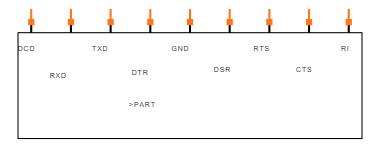
RS232 Symbol
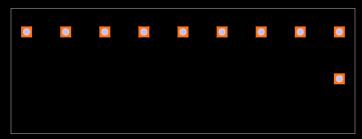
RS232 Footprint
DB9 3D Model
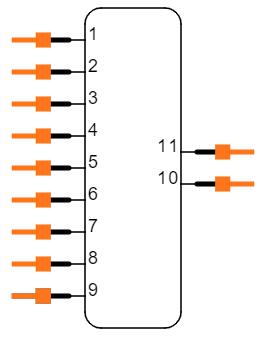
DB9 Symbol
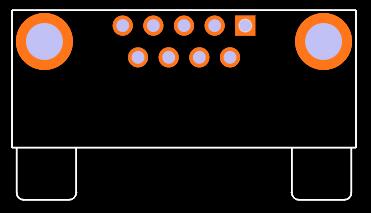
DB9 Footprint
RS232 VS DB9 Features
RS232 Features
Features molded hoods and thumbscrews that enable a snug fit when making connections.
All nine pins are wired straight through.
DB9 Features
DB9 protects 9 pin serial connections for data line surge suppression of data terminal, data communications equipment and PCs, printers, modems, and more
Reversible for use with male or female captive DB9 ports
Offers protection on all 9 data lines, plus D shell chassis
Surge suppression utilizing high-speed avalanche diodes divert excess energies on the network to
Ground
Advantages and Disadvantages of RS232
RS232 Advantages
RS232 interface is supported in many compatible legacy devices due to its simplicity. It is widely used for point-to-point connections between DTE and DCE devices.
It supports long distances of about 50 feet (for low baud rates) and with error correction capabilities.
RS232 is immune to noise due to the use of +/-5 Volts or higher for binary logic 0 and logic 1.
RS232 is a low-cost interface.
Converters or adaptors are available at cheaper rates for conversion from RS232 to RS485/USB/Ethernet etc.
RS232 Disadvantages
It is suitable for system-to-system communications. It is not suitable for chip to chip or chip to sensor device communications.
Supports lower speed for long distances. Higher speed (i.e. 115200 baud) can be achieved for short distances only.
RS232 interface requires separate transceiver chips which will add cost to the system.
It is used for single master and single slave configuration and not for single master-multiple slaves mode.
It is an unbalanced transmission.
Advantages and Disadvantages of DB9
DB9 Advantages
DB9 connectors have several advantages. You can easily customize them with 9 individual pins to carry serial data. Although the speed of these connectors is low as compared to other standards like USB, the length of these cables is quite long. For eg, USB has a five-meter length limit, but RS-232, which is the most commonly used standard for serial data doesn’t have a particularly defined length limit. RS-422 has been used at length which is hundreds of meters long with special equipment.
In case you have an old device having DB9 connectors on it, you will find several options for conversions. Converters from other standards like USB, Ethernet, etc also enable you to make use of your device on any computer.
DB9 Disadvantages
As the connectors are large, it becomes difficult to connect and disconnect them in small spaces. The pins of these cables are usually exposed so there are more chances for them to get damaged or break. Although you can mate the connector without any thumbscrew hardware, there are fewer chances that it will hold on to the equipment. On the other hand, if you use thumbscrews, the connector will take a long time to get plugged and unplugged.
And as mentioned before, serial communication is a slow and old way of exchanging data. So the speed is quite slow when there are cables of long length. This also causes breaks in communication and makes the software of PC freeze. Due to such issues, other standards gained more popularity over DB9 cables.
But this in no way means that DB9 connectors aren’t used. If you use right-angle adapters, they can help you solve the tight space issue without causing any damage to the connector. You can attach the connectors with D-Subminiature plug and jack covers which can protect pins from getting damaged when not being used.
Before you make a buy for DB9 connectors, make sure you precisely know what your needs are. If there is a smart alternative for DB9 cables, you can go for that as well!
What is the difference between DB9 and RS232?
The serial interface is defined by RS232, which includes things like signal voltage and duration. The 9-pin connector is known as DB9. These connectors are commonly used for RS232 connections, but there is also a 25-pin connector. RS232 is the definition of the serial interface, e.g. the signal voltage and duration. DB9 is the 9-pin connector. RS232 connections are frequently implemented using these connectors, but there is a 25-pin connector also. But of course, you can solder the cable to the devices directly also, without a DB9 or DB25 connector.
DB9 Manufacturer
Outstanding product reliability and exceptional service have been Tripp Lite's trademarks for over 95 years. Tripp Lite manufactures over 4,000 products to power and connect the computers, networking equipment, and electronic devices that form the foundation of our connected world. On the desktop, in the data center, wherever power and information flow, products and services that solve customers' problems and meet their highest expectations are the hallmarks of a Tripp Lite solution. Headquartered in Chicago, Illinois, Tripp Lite maintains a global presence with offices and partners worldwide.
RS232 and DB9 Datasheet
Popularity by Region
Parts with Similar Specs
Is DB9 same as RS-232?
RS232 is the definition of the serial interface, e.g. the signal voltage and duration. DB9 is the 9 pin connector. RS232 connections are frequently implemented using these connectors, but there is a 25 pin connector also.
What computer cable has 9 pins?
DB9
What is the difference between DB9 and DB25?
DB9 was a 9 pin connector and DB25 was a 25 pin connector. They were used for peripherals such as serial printers, mice, game controllers, and modems. We always called them RS-232 ports or a COM port.
What is a RS-232 cable?
RS232 is a standard protocol used for serial communication, it is used for connecting computers and its peripheral devices to allow serial data exchange between them. ... These connectors are known as the DB-9 Connector as a serial port and they are of two type's Male connectors (DTE) & Female connector (DCE).
How do I connect my DB9 to my laptop?
Plug the serial DB-9 end of the console cable into the serial DB-9 port on your laptop. If your laptop has no serial DB-9 port, plug the serial DB-9 end of the console cable into the serial DB-9 end of a USB to serial DB-9 adapter and then into a USB port on your laptop.
 MAX3311 Transceiver: Pinout, Equivalent and Datasheet
21 January 2022739
 MPF102 N-Channel JFET: Datasheet, Pinout, and Equivalents
26 August 20217102
 Panasonic ERJ-6GEY0R00V 0-Ohm Resistor: 5 Key Applications in Modern Electronics
11 October 20251448
![STA8088EXG RF RX GALILEO 1.575GHZ 169TFBGA[FAQ]: Datasheet, Block Diagram, and Features](https://res.utmel.com/Images/Article/3fe63125-18b6-441c-8483-4490b58e8e35.jpg) STA8088EXG RF RX GALILEO 1.575GHZ 169TFBGA[FAQ]: Datasheet, Block Diagram, and Features
STA8088EXG RF RX GALILEO 1.575GHZ 169TFBGA[FAQ]: Datasheet, Block Diagram, and Features14 March 2022807
 PC817 Photocoupler: Datasheet, Pinout, Equivalents
29 September 202123327
![2N2907A Small Signal PNP Transistors: Pinout, Datasheet pdf and Equivalent [Video]](https://res.utmel.com/Images/Article/e3cebe8c-d535-40d4-af81-ca08b3da049a.jpg) 2N2907A Small Signal PNP Transistors: Pinout, Datasheet pdf and Equivalent [Video]
2N2907A Small Signal PNP Transistors: Pinout, Datasheet pdf and Equivalent [Video]15 December 20215413
 A Comprehensive Guide to OP97EN8#PBF Linear Amplifier
06 March 2024162
 ATtiny202 tinyAVR 0-series 20MHz Microcontroller: Datasheet, Pinout, and UPDI Programming Analysis
10 March 20261379
 What are Avalanche Diodes?
02 April 202013997
 What Is a Shunt (Resistor)? How Current Sensing Works and How to Choose
17 July 20268256
 Foreign Media Burst Samsung: DRAM, Foundry and Chip Defeat on All Fronts
20 April 20223337
 What is DDR5 SDRAM? The Ultimate Guide to Specs, Architecture, and Market Trends
05 January 202611914
 How do Inductors Work?
27 October 202516638
 Analysis and Solutions of Common Causes of Serial Port Lost Data
15 August 20225220
 What is Sequential Logic?
15 October 20208112
 Review of IoT-Based Smart Home Security Systems- Part 1
28 March 20244086
Tripp Lite
In Stock
United States
China
Canada
Japan
Russia
Germany
United Kingdom
Singapore
Italy
Hong Kong(China)
Taiwan(China)
France
Korea
Mexico
Netherlands
Malaysia
Austria
Spain
Switzerland
Poland
Thailand
Vietnam
India
United Arab Emirates
Afghanistan
Åland Islands
Albania
Algeria
American Samoa
Andorra
Angola
Anguilla
Antigua & Barbuda
Argentina
Armenia
Aruba
Australia
Azerbaijan
Bahamas
Bahrain
Bangladesh
Barbados
Belarus
Belgium
Belize
Benin
Bermuda
Bhutan
Bolivia
Bonaire, Sint Eustatius and Saba
Bosnia & Herzegovina
Botswana
Brazil
British Indian Ocean Territory
British Virgin Islands
Brunei
Bulgaria
Burkina Faso
Burundi
Cabo Verde
Cambodia
Cameroon
Cayman Islands
Central African Republic
Chad
Chile
Christmas Island
Cocos (Keeling) Islands
Colombia
Comoros
Congo
Congo (DRC)
Cook Islands
Costa Rica
Côte d’Ivoire
Croatia
Cuba
Curaçao
Cyprus
Czechia
Denmark
Djibouti
Dominica
Dominican Republic
Ecuador
Egypt
El Salvador
Equatorial Guinea
Eritrea
Estonia
Eswatini
Ethiopia
Falkland Islands
Faroe Islands
Fiji
Finland
French Guiana
French Polynesia
Gabon
Gambia
Georgia
Ghana
Gibraltar
Greece
Greenland
Grenada
Guadeloupe
Guam
Guatemala
Guernsey
Guinea
Guinea-Bissau
Guyana
Haiti
Honduras
Hungary
Iceland
Indonesia
Iran
Iraq
Ireland
Isle of Man
Israel
Jamaica
Jersey
Jordan
Kazakhstan
Kenya
Kiribati
Kosovo
Kuwait
Kyrgyzstan
Laos
Latvia
Lebanon
Lesotho
Liberia
Libya
Liechtenstein
Lithuania
Luxembourg
Macao(China)
Madagascar
Malawi
Maldives
Mali
Malta
Marshall Islands
Martinique
Mauritania
Mauritius
Mayotte
Micronesia
Moldova
Monaco
Mongolia
Montenegro
Montserrat
Morocco
Mozambique
Myanmar
Namibia
Nauru
Nepal
New Caledonia
New Zealand
Nicaragua
Niger
Nigeria
Niue
Norfolk Island
North Korea
North Macedonia
Northern Mariana Islands
Norway
Oman
Pakistan
Palau
Palestinian Authority
Panama
Papua New Guinea
Paraguay
Peru
Philippines
Pitcairn Islands
Portugal
Puerto Rico
Qatar
Réunion
Romania
Rwanda
Samoa
San Marino
São Tomé & Príncipe
Saudi Arabia
Senegal
Serbia
Seychelles
Sierra Leone
Sint Maarten
Slovakia
Slovenia
Solomon Islands
Somalia
South Africa
South Sudan
Sri Lanka
St Helena, Ascension, Tristan da Cunha
St. Barthélemy
St. Kitts & Nevis
St. Lucia
St. Martin
St. Pierre & Miquelon
St. Vincent & Grenadines
Sudan
Suriname
Svalbard & Jan Mayen
Sweden
Syria
Tajikistan
Tanzania
Timor-Leste
Togo
Tokelau
Tonga
Trinidad & Tobago
Tunisia
Turkey
Turkmenistan
Turks & Caicos Islands
Tuvalu
U.S. Outlying Islands
U.S. Virgin Islands
Uganda
Ukraine
Uruguay
Uzbekistan
Vanuatu
Vatican City
Venezuela
Wallis & Futuna
Yemen
Zambia
Zimbabwe
![EZA-VGACSAF-2]() EZA-VGACSAF-2
EZA-VGACSAF-2Tripp Lite
![U026-15M]() U026-15M
U026-15MTripp Lite
![BHDBT-T-SI-4X4]() BHDBT-T-SI-4X4
BHDBT-T-SI-4X4Tripp Lite
![B126-1A0-WP-1]() B126-1A0-WP-1
B126-1A0-WP-1Tripp Lite
![B126-004]() B126-004
B126-004Tripp Lite
![B125-101-60-IRU]() B125-101-60-IRU
B125-101-60-IRUTripp Lite
![B126-2A0]() B126-2A0
B126-2A0Tripp Lite
![MR2208G]() MR2208G
MR2208GTripp Lite
![U339-002]() U339-002
U339-002Tripp Lite


