

 Product
 Brand
Brand Articles
 Tools
Tools
What is the difference between IRF640 and IRF740: IRF640 vs. IRF740


N-Channel Tube 550m Ω @ 5.3A, 10V ±20V 1400pF @ 25V 43nC @ 10V TO-220-3
This post will show you the differences between IRF640 and IRF740 from different angles. There is a huge range of Semiconductors, Capacitors, Resistors and ICs in stock. Welcome RFQ!

Top 5 DIY Projects using MOSFET, awesome diy ideas
IRF640 vs. IRF740: Pinout
The pinouts are shown below which is no difference between them.
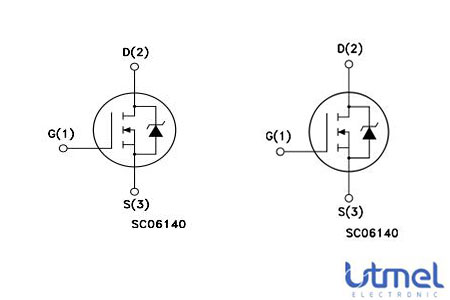
IRF740 Pinout vs. IRF640 Pinout
IRF640 vs. IRF740: CAD Model
Symbol
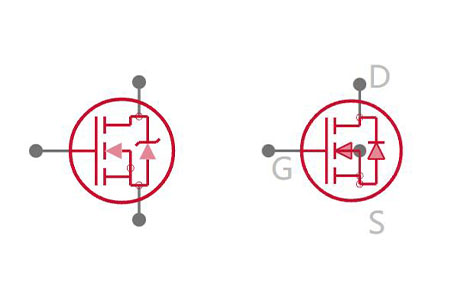
IRF640 vs. IRF740 Symbol
Footprint
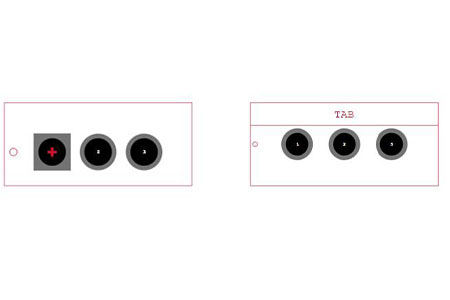
IRF640 vs. IRF740 Footprint
3D Model
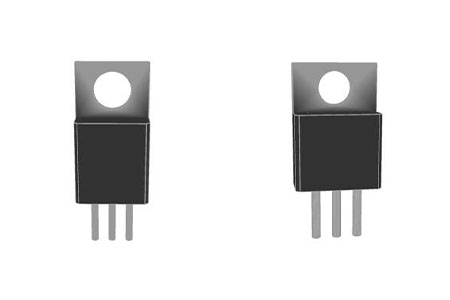
IRF740 vs. IRF640 3D Model
The Overview of IRF640
The IRF640 is an N Channel MOSFET that is developed for high-speed switching. This high-speed switching capacity can be extremely beneficial in applications where switching speed is critical, such as a UPS circuit or any other application where the load input power needs to be changed from one source to another.
The transistor can drive a load of up to 18A and has a voltage range of up to 200V, with a gate saturation voltage of only 2V to 4V. The pulsed drain current of 72A indicates that this MOSFET can drive loads of up to 72A for brief periods of time or when the load is only connected for 300us (microseconds) with a duty cycle of 1.5 percent.
The Overview of IRF740
The IRF740 is a high-voltage N-channel MOSFET that is primarily used in high-voltage, high-speed switching applications. This transistor can drive a maximum load voltage of 400V and a maximum load current of 10A. In pulse mode, the maximum current is 40A, and the on-resistance (RDS) is 0.55 ohms.

It is ideal for driving a range of high voltage loads in electronic circuits since it has a maximum drain to source voltage of 400V.
Parts with Similar Specs
IRF640 vs. IRF740: Application
IRF740 | IRF640 |
Applications that require fast switching | Battery Chargers and BMS |
High voltage applications | Solar Power Supply Applications |
Motor Drivers | Applications That Requires Fast Switching |
DC Motor drivers and controllers applications | Motor Drivers |
UPS | ups |
Battery charger circuits | |
Lighting and ballast circuits |
IRF640 vs. IRF740: Circuit
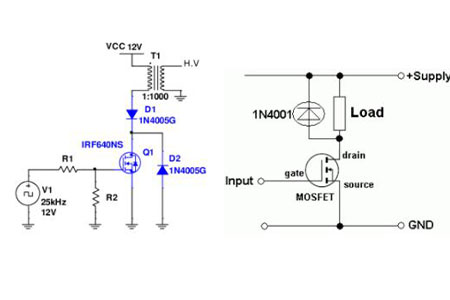
IRF640 vs. IRF740 Circuit
IRF640 vs. IRF740: How to Use?
IRF640 can be utilized in circuits where switching speed is critical, such as battery backup systems and uninterruptible power supply, as well as in general-purpose switching applications. Aside from that, it can be utilized as a component in audio amplifiers.
The IRF740 can be utilized in circuits that require a voltage load of up to 400V and current demand of 10A. It's also excellent for applications where the user needs to move from one source to another in nanoseconds, because to its high-speed switching capability.
It may be used in a number of high voltage applications, including uninterrupted power supply, LED and other light ballasts, and so on, thanks to its 400V load capabilities.
This transistor can also be utilized as a separate audio amplifier or in audio amplifier circuit stages.
IRF640 vs. IRF740: How to Make Them Safely Long Run in a Circuit?
How to Make IRF640 Safely Long Run in a Circuit?
We always recommend using components that are at least 20% below their maximum ratings for long-term performance, and the same is true for IRF640. Because the maximum drain current is 18A, no-load exceeding 14.4A should be driven. The maximum load voltage is 200V, and you should not drive a load higher than 160V to be on the safe side. Because the maximum pulsed drain current is 72A, the maximum pulsed load cannot exceed 57.6A. Always store or operate the transistor in a temperature range between -55 and +150 ℃.
How to Make IRF740 Safely Long Run in a Circuit?
It is critical to not use a component at its highest ratings for long-term performance, but rather at least 20% below its maximum ratings, as is the case with the IRF740 MOSFET. Because the maximum continuous drain current is 10A, do not drive loads that consume more than 8A. Because the maximum drain to source voltage is 400V, do not drive loads that are higher than 320V. Use a suitable heatsink with the transistor wherever it is in operation, and store and operate it at temperatures between -55 and +150 ℃.
IRF640 vs. IRF740:Datasheet PDF
Popularity by Region
What is IRF640?
The IRF640 is an N Channel MOSFET that is developed for high-speed switching. This high-speed switching capacity can be extremely beneficial in applications where switching speed is critical, such as a UPS circuit or any other application where the load input power needs to be changed from one source to another.
What is IRF740?
The IRF740 is a high-voltage N-channel MOSFET that is primarily used in high-voltage, high-speed switching applications. This transistor can drive a maximum load voltage of 400V and a maximum load current of 10A. In pulse mode, the maximum current is 40A, and the on-resistance (RDS) is 0.55 ohms. It is ideal for driving a range of high voltage loads in electronic circuits since it has a maximum drain to source voltage of 400V.
What is an N-channel Mosfet?
N-Channel MOSFET is a type of metal oxide semiconductor field-effect transistor that is categorized under the field-effect transistors (FET). ... This type of transistor is also known as an insulated-gate field-effect transistor (IGFET). Sometimes it is also known as a metal-insulator field-effect transistor (MIFET).
What is the difference between N-channel and P-channel MOSFETs?
As the applied gate voltage and drain, supply is positive for an n-channel enhancement MOSFET.Comparison of N Channel and P Channel MOSFETs.
How does an channel MOSFET work?
Working Principle of MOSFET. The main principle of the MOSFET device is to be able to control the voltage and current flow between the source and drain terminals. It works almost like a switch and the functionality of the device is based on the MOS capacitor. The MOS capacitor is the main part of MOSFET.
 Guide to onsemi MBRS360T3G Datasheets
19 August 2025271
 AD8367 500 MHz Variable Gain Amplifier: Datasheet, Pinout, and AGC Design Analysis
17 March 2026476
 XC7A200T-2FBG484I Xilinx FPGA Features and Applications Explained
26 March 20253284
 AD9508 1.65 GHz Clock Buffer: Datasheet, Ultra-Low Jitter Specs, and Configuration Analysis
21 April 2026386
 UC3843 Current Mode PWM Controller Design Guide
14 January 20263408
 BS170 N-Channel MOSFET: Pinout, Equivalent and Datasheet
03 September 202115803
 MC1458 Dual Op-Amp: Specifications, Design Limitations, and Modern Replacement Options
08 June 2026571
 LM567 Tone Decoder: Price, Pinout and Circuit
30 June 20216157
 What is Tantalum Capacitor: Structure, Failure and Application Guide
14 April 202221230
 Sourcing Silicon Capacitors and MLCCs in the AI Hardware Era
13 August 2026552
 Photonic Integrated Circuits: Overcoming Challenges in Silicon Photonics
26 August 20243252
 What is an Accelerometer: Definition, Types and Applications
02 April 202210283
 Optocouplers Guide: Understanding Types, Applications, and Circuit Design Tutorial
06 June 20254626
 What are Laser Diodes?
20 October 202517764
 Effect Of Target Physical Properties And Energetic Ions When Doping Thin-Body Semiconductor
19 October 20222587
 What is Brushless DC Motors (BLDC) ?
03 April 20258929
STMicroelectronics
In Stock
United States
China
Canada
Japan
Russia
Germany
United Kingdom
Singapore
Italy
Hong Kong(China)
Taiwan(China)
France
Korea
Mexico
Netherlands
Malaysia
Austria
Spain
Switzerland
Poland
Thailand
Vietnam
India
United Arab Emirates
Afghanistan
Åland Islands
Albania
Algeria
American Samoa
Andorra
Angola
Anguilla
Antigua & Barbuda
Argentina
Armenia
Aruba
Australia
Azerbaijan
Bahamas
Bahrain
Bangladesh
Barbados
Belarus
Belgium
Belize
Benin
Bermuda
Bhutan
Bolivia
Bonaire, Sint Eustatius and Saba
Bosnia & Herzegovina
Botswana
Brazil
British Indian Ocean Territory
British Virgin Islands
Brunei
Bulgaria
Burkina Faso
Burundi
Cabo Verde
Cambodia
Cameroon
Cayman Islands
Central African Republic
Chad
Chile
Christmas Island
Cocos (Keeling) Islands
Colombia
Comoros
Congo
Congo (DRC)
Cook Islands
Costa Rica
Côte d’Ivoire
Croatia
Cuba
Curaçao
Cyprus
Czechia
Denmark
Djibouti
Dominica
Dominican Republic
Ecuador
Egypt
El Salvador
Equatorial Guinea
Eritrea
Estonia
Eswatini
Ethiopia
Falkland Islands
Faroe Islands
Fiji
Finland
French Guiana
French Polynesia
Gabon
Gambia
Georgia
Ghana
Gibraltar
Greece
Greenland
Grenada
Guadeloupe
Guam
Guatemala
Guernsey
Guinea
Guinea-Bissau
Guyana
Haiti
Honduras
Hungary
Iceland
Indonesia
Iran
Iraq
Ireland
Isle of Man
Israel
Jamaica
Jersey
Jordan
Kazakhstan
Kenya
Kiribati
Kosovo
Kuwait
Kyrgyzstan
Laos
Latvia
Lebanon
Lesotho
Liberia
Libya
Liechtenstein
Lithuania
Luxembourg
Macao(China)
Madagascar
Malawi
Maldives
Mali
Malta
Marshall Islands
Martinique
Mauritania
Mauritius
Mayotte
Micronesia
Moldova
Monaco
Mongolia
Montenegro
Montserrat
Morocco
Mozambique
Myanmar
Namibia
Nauru
Nepal
New Caledonia
New Zealand
Nicaragua
Niger
Nigeria
Niue
Norfolk Island
North Korea
North Macedonia
Northern Mariana Islands
Norway
Oman
Pakistan
Palau
Palestinian Authority
Panama
Papua New Guinea
Paraguay
Peru
Philippines
Pitcairn Islands
Portugal
Puerto Rico
Qatar
Réunion
Romania
Rwanda
Samoa
San Marino
São Tomé & Príncipe
Saudi Arabia
Senegal
Serbia
Seychelles
Sierra Leone
Sint Maarten
Slovakia
Slovenia
Solomon Islands
Somalia
South Africa
South Sudan
Sri Lanka
St Helena, Ascension, Tristan da Cunha
St. Barthélemy
St. Kitts & Nevis
St. Lucia
St. Martin
St. Pierre & Miquelon
St. Vincent & Grenadines
Sudan
Suriname
Svalbard & Jan Mayen
Sweden
Syria
Tajikistan
Tanzania
Timor-Leste
Togo
Tokelau
Tonga
Trinidad & Tobago
Tunisia
Turkey
Turkmenistan
Turks & Caicos Islands
Tuvalu
U.S. Outlying Islands
U.S. Virgin Islands
Uganda
Ukraine
Uruguay
Uzbekistan
Vanuatu
Vatican City
Venezuela
Wallis & Futuna
Yemen
Zambia
Zimbabwe
![STW9NK90Z]() STW9NK90Z
STW9NK90ZSTMicroelectronics
![STD20NF20]() STD20NF20
STD20NF20STMicroelectronics
![STP80NF10]() STP80NF10
STP80NF10STMicroelectronics
![STW9N150]() STW9N150
STW9N150STMicroelectronics
![STW11NK100Z]() STW11NK100Z
STW11NK100ZSTMicroelectronics
![STH3N150-2]() STH3N150-2
STH3N150-2STMicroelectronics
![STP12NM50FP]() STP12NM50FP
STP12NM50FPSTMicroelectronics
![STW45NM60]() STW45NM60
STW45NM60STMicroelectronics
![STP11NK50ZFP]() STP11NK50ZFP
STP11NK50ZFPSTMicroelectronics
![STP12NM50]() STP12NM50
STP12NM50STMicroelectronics


