

 Product
 Brand
Brand Articles
 Tools
Tools
AD636 800μA True RMS-to-DC Converter: Datasheet, Specs, and Performance Analysis


Gold 10 130 kHz kHz RMS to DC Converters TO-100-10 Metal Can 500mW mW 1mA μA
The AD636 is a precision 800μA RMS-to-DC converter. Explore datasheet specs, pinouts, and equivalents to optimize your low-power AC measurement designs. Buy now.
- Executive Summary: What is the AD636?
- 1. Technical Specifications & Performance Analysis
- 2. Pinout, Package, and Configuration
- 3. Design & Integration Guide (For Engineers & Makers)
- 4. Typical Applications & Use Cases
- 5. Alternatives and Cross-Reference Guide
- 6. Frequently Asked Questions (FAQ)
- 7. Resources
- Specifications
- Parts with Similar Specs
- Datasheet PDF
Executive Summary: What is the AD636?
The AD636 is a low-power, monolithic integrated circuit designed for performing true RMS-to-DC conversion on low-level signals with hybrid-level precision. By accurately calculating the root-mean-square of complex AC and DC waveforms, it provides engineers with a highly stable measurement solution that outperforms standard rectifying circuits.
Market Position: A premium-tier, high-precision analog IC tailored for low-power and portable instrumentation where accuracy is paramount.
Top Features: Ultra-low 800 μA quiescent current, capability to handle a signal crest factor of 6 (for 0.5% error), and laser-trimmed accuracy yielding a 200 mV full-scale input range.
Primary Audience: Hardware engineers, test equipment designers, and advanced hobbyists building battery-powered multimeters, audio analyzers, and precision IoT sensors.
Supply Status: Active and widely integrated into legacy and modern precision test designs.
1. Technical Specifications & Performance Analysis
1.1 Core Architecture (CPU/Logic/Power)
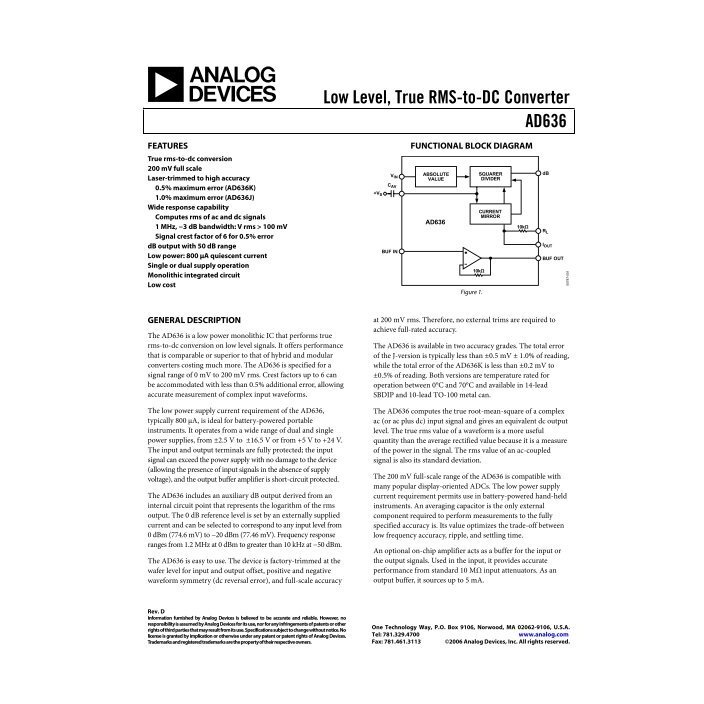
At its core, the AD636 utilizes a highly optimized analog computing matrix to perform true RMS-to-DC conversion. Unlike standard peak-detecting or averaging rectifiers that only provide accurate readings for pure sine waves, the AD636 computes the true heating value of complex, non-sinusoidal signals. This monolithic architecture features an onboard buffer amplifier and an auxiliary dB output, making it highly versatile for audio and RF power measurement applications.
1.2 Key Electrical Characteristics
The AD636 is engineered for maximum performance within strict thermal and power budgets. Its low power consumption makes it an exceptional choice for battery-operated BOMs.
Quiescent Current: 800 μA (Maximizes battery life in portable designs)
Signal Range: 0 mV to 200 mV rms
Supply Voltage: ±2.5 V to ±16.5 V (Dual Supply) or +5 V to +24 V (Single Supply)
Bandwidth: 1.2 MHz at 0 dBm (-3 dB bandwidth is 1 MHz for V rms > 100 mV)
Crest Factor Handling: Up to 6 (Ensures accuracy even with highly distorted waveforms)
1.3 Interfaces and Connectivity
The AD636 relies on purely analog interfaces. It outputs a linear DC voltage directly proportional to the RMS value of the input signal. Additionally, it features a dedicated dB output with a 50 dB range, which is highly beneficial for audio test equipment and impedance analyzers requiring logarithmic scaling.
2. Pinout, Package, and Configuration
2.1 Pin Configuration Guide
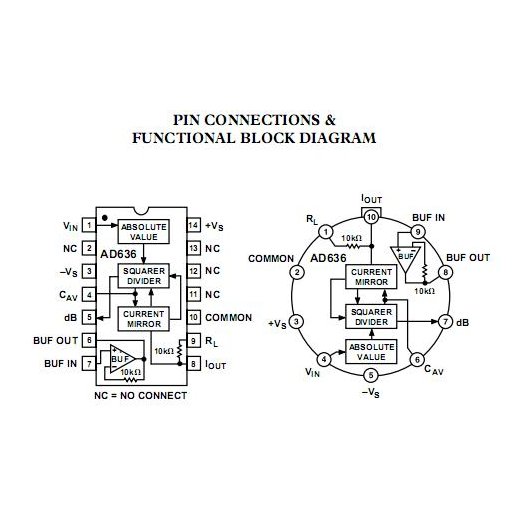
While the exact pinout depends on the package (DIP vs. TO-100), the schematic symbol generally includes the following critical connections: * +Vs / -Vs: Positive and negative supply voltage pins (supports single or dual rails). * IN: The low-level AC/DC signal input (200 mV full scale). * OUT: The linear DC voltage output representing the RMS value. * dB OUT: Logarithmic output for audio/RF scaling. * CAV: Connection for the external averaging capacitor, crucial for setting the integration time constant.
2.2 Naming Convention & Ordering Codes
Understanding the Part Numbers:Procurement Managers must pay close attention to the suffix of the AD636, as it dictates the laser-trimmed accuracy and price vs performance ratio: * AD636K: Premium grade, featuring a maximum error of just 0.5%. * AD636J: Standard grade, featuring a maximum error of 1.0%. * Package Suffixes: Suffixes like 'N' (PDIP), 'R' (SOIC), or 'H' (Metal Can) dictate the physical footprint for PCB assembly.
2.3 Available Packages
| Package Type | Dimensions | Common Use Case |
|---|---|---|
| 14-Lead PDIP | Standard Through-Hole | Prototyping, advanced hobbyist projects, hand-soldering. |
| 10-Pin TO-100 | Metal Can | High-reliability, aerospace, or legacy industrial equipment. |
| 16-Lead SOIC | Surface Mount | High-volume machine assembly and compact portable instruments. |
3. Design & Integration Guide (For Engineers & Makers)
Pro Tip: Always verify pin compatibility and carefully calculate your CAV capacitor value before migrating from older series converters to the AD636.
3.1 Hardware Implementation
Bypass Capacitors: Place 0.1 µF ceramic capacitors as close to the supply pins as possible to filter out high-frequency noise that could distort low-level 200mV inputs.
PCB Layout: Keep the trace to the
CAVpin extremely short. Use guard rings around the input pins to prevent leakage currents from degrading the high accuracy of the IC.Thermal Management: With a quiescent current of just 800 μA, the AD636 generates negligible heat. No external heatsink is required.
3.2 Common Design Challenges
Issue: Low Frequency Measurement Error
Desc: The device can exhibit ripple and error when measuring low-frequency inputs, heavily dependent on the averaging capacitor.
Fix: Select an appropriate averaging capacitor (
CAV, typically around 4 µF) to optimize the trade-off between low-frequency accuracy, output ripple, and settling time.Issue: Negative Output Swing Limitation
Desc: When using the internal buffer amplifier in dual-supply applications to drive a grounded load, the negative voltage swing may be restricted.
Fix: Add an external resistor in parallel with the emitter resistor (RE) to alter the internal voltage divider, allowing for an increased negative swing.
Issue: High Component Cost
Desc: The AD636 is a premium IC and may break the budget for simple hobbyist designs.
Fix: Evaluate if a crest factor of 6 and 0.5% precision are strictly necessary. If not, consider a software-based microcontroller ADC implementation or a lower-cost alternative like the AD737.
4. Typical Applications & Use Cases
Watch Tutorial: AD636
4.1 Real-World Example: High-End Handheld Multimeters
In a professional-grade battery-powered multimeter, standard peak-detecting rectifiers fail to accurately measure distorted AC mains voltages or pulsed motor drive signals. The AD636 is deployed as the core measurement engine because it effortlessly handles complex AC waveforms with crest factors up to 6. Its ultra-low 800 µA power draw ensures the multimeter can run for hundreds of hours on a single 9V battery, while its 200 mV full-scale input perfectly matches standard current shunt voltage drops.
Other Common Applications:* Audio test equipment (utilizing the dB output) * Impedance analyzers and ESR meters * Battery-powered portable instruments
5. Alternatives and Cross-Reference Guide
When balancing price vs performance, or navigating supply chain shortages, consider these AD636 datasheet equivalents and alternatives:
Direct Replacements: The Maxim Integrated AD636KCWE serves as a direct second-source alternative, offering identical pinout and spec compatibility for drop-in replacements.
Better Performance (Higher Bandwidth): If your design requires broader frequency handling and can tolerate higher power consumption, upgrade to the Analog Devices AD637 or AD536A.
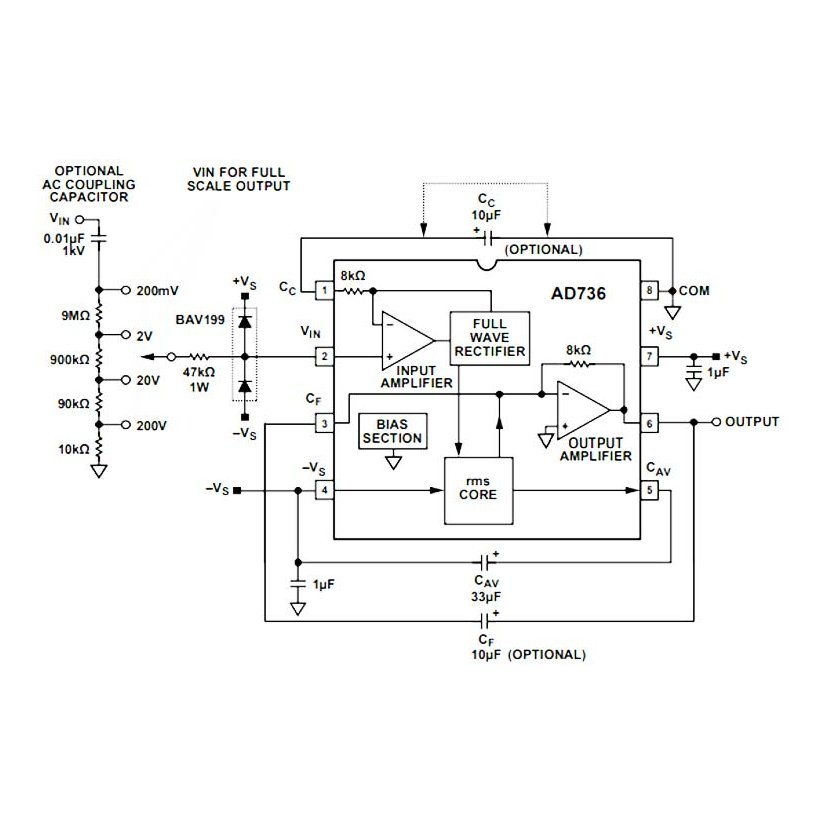
Cost-Effective Options: For budget-constrained projects that still require true RMS capabilities but can sacrifice some precision or crest factor handling, the Analog Devices AD737 or AD736 are excellent, lower-cost alternatives.
6. Frequently Asked Questions (FAQ)
Q: What is the difference between the AD636 and the AD637? A: The AD636 is optimized for low power (800 μA) and low-level signals (200 mV full scale), making it ideal for battery-operated devices. The AD637 consumes more power but offers much higher bandwidth (up to 8 MHz) and handles larger input signals.
Q: Can the AD636 be used in battery-operated devices? A: Absolutely. With its low 800 μA quiescent current and ability to operate on a single supply (+5 V to +24 V), it is explicitly designed for portable, battery-powered instrumentation.
Q: How do I program or configure the AD636? A: The AD636 is a purely analog IC and does not require software programming. It is configured entirely via hardware, primarily by selecting the correct external averaging capacitor (
CAV) and setting the appropriate supply rails.Q: Where can I find the AD636 datasheet and schematic symbol? A: The official datasheet, application notes, and CAD library files (including schematic symbols and footprints) can be found on the Analog Devices website or through major electronic component distributors.
7. Resources
Development Tools & Software: Analog Devices provides LTspice models for simulating the AD636 in various application circuits before committing to a PCB layout. Evaluation boards are also available for rapid prototyping.
Specifications
Parts with Similar Specs
- ImagePart NumberManufacturerPackage / CaseNumber of PinsSupply VoltageOperating Supply CurrentConverter TypeMin Operating TemperatureOperating Frequency-MaxPositive Input Voltage-MaxView Compare
![AD636JHZ]()
AD636JHZ
TO-100-10 Metal Can
10
3 V
1 mA
RMS TO DC CONVERTER
0 °C
0.1 MHz
0.2 V
![AD636JH]()
TO-100
10
3 V
1 mA
RMS TO DC CONVERTER
0 °C
0.1 MHz
0.2 V


Datasheet PDF
- Datasheets :
- ConflictMineralStatement :
 A Comprehensive Guide to LTC6957HMS-3#TRPBF Clock Buffer by Linear Technology/Analog Devices
06 March 2024484
![C106D Thyristor: Circuits, Pinout, and Datasheet [Video]](https://res.utmel.com/Images/Article/d67d29cd-e061-4abc-832a-4d1631d57c61.png) C106D Thyristor: Circuits, Pinout, and Datasheet [Video]
C106D Thyristor: Circuits, Pinout, and Datasheet [Video]11 January 202222444
 M95040-W Serial SPI bus EEPROM: Pinout, Equivalent and Datasheet
14 January 20225650
 LIS3DHTR accelerometer: Datasheet, Pinout and Features
20 July 20213214
 ATtiny4313 Microcontroller: Pinout, Datasheet, Block Diagram
26 October 20211929
 AD6623ASZ Transmit Signal Processor: Pinout, Specification, Datasheet
25 May 2021636
![S9014 Transistor: Pinout, Datasheet and Circuit [Video&FAQ]](https://res.utmel.com/Images/Article/b4d58d10-6f12-40f3-a348-8439a1be6520.png) S9014 Transistor: Pinout, Datasheet and Circuit [Video&FAQ]
S9014 Transistor: Pinout, Datasheet and Circuit [Video&FAQ]28 September 202147749
 IRF1407 Power MOSFET: Pinout, Datasheet and Test Circuit
08 November 20218847
 Xilinx FPGAs: From Getting Started to Advanced Application Development
09 September 20255114
 Google Acquires MicroLED Display Company Raxium, May Boost Its AR Headset
09 May 20222338
 The Introduction of Oscilloscope Probes
11 January 20228133
 What Is a Shunt (Resistor)? How Current Sensing Works and How to Choose
17 July 20268295
 Silicon Carbide Substrate Manufacturing: Advancing Technology to New Heights
08 June 20233800
 What is RF Switch?
16 November 20217769
 What is a Variable Resistor?
10 June 202631950
 The Rise of Co-Packaged Optics (CPO) and Silicon Photonics in AI Superclusters
24 June 20262703
Analog Devices Inc.
In Stock: 688
United States
China
Canada
Japan
Russia
Germany
United Kingdom
Singapore
Italy
Hong Kong(China)
Taiwan(China)
France
Korea
Mexico
Netherlands
Malaysia
Austria
Spain
Switzerland
Poland
Thailand
Vietnam
India
United Arab Emirates
Afghanistan
Åland Islands
Albania
Algeria
American Samoa
Andorra
Angola
Anguilla
Antigua & Barbuda
Argentina
Armenia
Aruba
Australia
Azerbaijan
Bahamas
Bahrain
Bangladesh
Barbados
Belarus
Belgium
Belize
Benin
Bermuda
Bhutan
Bolivia
Bonaire, Sint Eustatius and Saba
Bosnia & Herzegovina
Botswana
Brazil
British Indian Ocean Territory
British Virgin Islands
Brunei
Bulgaria
Burkina Faso
Burundi
Cabo Verde
Cambodia
Cameroon
Cayman Islands
Central African Republic
Chad
Chile
Christmas Island
Cocos (Keeling) Islands
Colombia
Comoros
Congo
Congo (DRC)
Cook Islands
Costa Rica
Côte d’Ivoire
Croatia
Cuba
Curaçao
Cyprus
Czechia
Denmark
Djibouti
Dominica
Dominican Republic
Ecuador
Egypt
El Salvador
Equatorial Guinea
Eritrea
Estonia
Eswatini
Ethiopia
Falkland Islands
Faroe Islands
Fiji
Finland
French Guiana
French Polynesia
Gabon
Gambia
Georgia
Ghana
Gibraltar
Greece
Greenland
Grenada
Guadeloupe
Guam
Guatemala
Guernsey
Guinea
Guinea-Bissau
Guyana
Haiti
Honduras
Hungary
Iceland
Indonesia
Iran
Iraq
Ireland
Isle of Man
Israel
Jamaica
Jersey
Jordan
Kazakhstan
Kenya
Kiribati
Kosovo
Kuwait
Kyrgyzstan
Laos
Latvia
Lebanon
Lesotho
Liberia
Libya
Liechtenstein
Lithuania
Luxembourg
Macao(China)
Madagascar
Malawi
Maldives
Mali
Malta
Marshall Islands
Martinique
Mauritania
Mauritius
Mayotte
Micronesia
Moldova
Monaco
Mongolia
Montenegro
Montserrat
Morocco
Mozambique
Myanmar
Namibia
Nauru
Nepal
New Caledonia
New Zealand
Nicaragua
Niger
Nigeria
Niue
Norfolk Island
North Korea
North Macedonia
Northern Mariana Islands
Norway
Oman
Pakistan
Palau
Palestinian Authority
Panama
Papua New Guinea
Paraguay
Peru
Philippines
Pitcairn Islands
Portugal
Puerto Rico
Qatar
Réunion
Romania
Rwanda
Samoa
San Marino
São Tomé & Príncipe
Saudi Arabia
Senegal
Serbia
Seychelles
Sierra Leone
Sint Maarten
Slovakia
Slovenia
Solomon Islands
Somalia
South Africa
South Sudan
Sri Lanka
St Helena, Ascension, Tristan da Cunha
St. Barthélemy
St. Kitts & Nevis
St. Lucia
St. Martin
St. Pierre & Miquelon
St. Vincent & Grenadines
Sudan
Suriname
Svalbard & Jan Mayen
Sweden
Syria
Tajikistan
Tanzania
Timor-Leste
Togo
Tokelau
Tonga
Trinidad & Tobago
Tunisia
Turkey
Turkmenistan
Turks & Caicos Islands
Tuvalu
U.S. Outlying Islands
U.S. Virgin Islands
Uganda
Ukraine
Uruguay
Uzbekistan
Vanuatu
Vatican City
Venezuela
Wallis & Futuna
Yemen
Zambia
Zimbabwe
![AD736JNZ]() AD736JNZ
AD736JNZAnalog Devices Inc.
![AD8436ACPZ-R7]() AD8436ACPZ-R7
AD8436ACPZ-R7Analog Devices Inc.
![AD536AJHZ]() AD536AJHZ
AD536AJHZAnalog Devices Inc.
![AD536AJQ]() AD536AJQ
AD536AJQAnalog Devices Inc.
![AD536AJDZ]() AD536AJDZ
AD536AJDZAnalog Devices Inc.
![AD737JRZ]() AD737JRZ
AD737JRZAnalog Devices Inc.
![AD536AJD]() AD536AJD
AD536AJDAnalog Devices Inc.
![AD637JRZ-RL]() AD637JRZ-RL
AD637JRZ-RLAnalog Devices Inc.
![AD8436BRQZ]() AD8436BRQZ
AD8436BRQZAnalog Devices Inc.
![AD637JRZ]() AD637JRZ
AD637JRZAnalog Devices Inc.


