

 Product
 Brand
Brand Articles
 Tools
Tools
CA3140E Operational Amplifier: Diagram, Pinout, and Datasheet


40mA per Channel 10pA 90 dB Instrumentational OP Amps DIP
The CA3140E is a single monolithic chip that combines the advantages of high voltage PMOS and high voltage bipolar transistors in a single integrated circuit operational amplifier. This article mainly introduces diagram, pinout, datasheet and other detailed information about Intersil (Renesas Electronics America) CA3140E.

How to Make Efficient Automatic Street Light System using IC CA3140 (Op Amp)
- CA3140E Description
- CA3140E Pinout
- CA3140E CAD Model
- CA3140E Features
- Specifications
- Parts with Similar Specs
- CA3140E Functional Block Diagram
- CA3140E Schematic Diagram
- Where to use the CA3140 IC
- How to use the CA3140 IC
- CA3140 Equivalent
- CA3140E Alternatives
- CA3140E Applications
- CA3140E Package
- CA3140E Manufacturer
- Trend Analysis
- Datasheet PDF
CA3140E Description
The CA3140E is a single monolithic chip that combines the advantages of high voltage PMOS and high voltage bipolar transistors in a single integrated circuit operational amplifier.
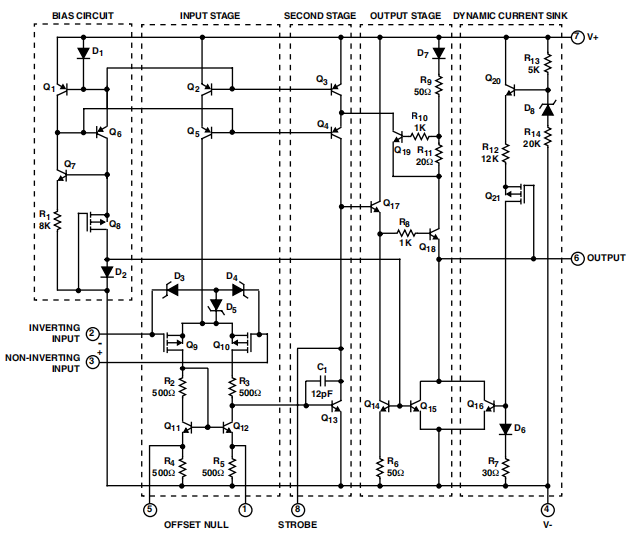
The gate-protected MOSFET (PMOS) transistors in the input circuit of the CA3140E BiMOS operational amplifier provide very high input impedance, very low input current, and high-speed performance. The CA3140E has a supply voltage range of 4 to 36 volts (either single or dual supply).
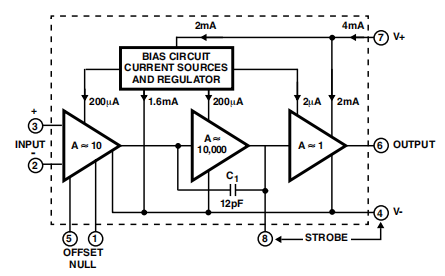
These operational amplifiers are intrinsically phase corrected for steady operation in unity gain follower mode, and they also provide an access terminal for an extra external capacitor if further frequency roll-off is needed. In addition, terminals are provided for applications that require input offset voltage nulling. The use of PMOS field-effect transistors in the input stage results in a common-mode input voltage capability of 0.5V below the negative supply terminal, which is a critical feature for single-supply applications. Bipolar transistors are used in the output stage, and there is built-in safety against damage from load terminal short-circuiting to either the supply rail or ground.
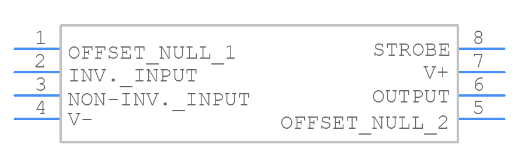
CA3140E Pinout
The following figure is CA3140E Pinout.

Pinout
| Pin Number | Pin Name | Description |
| 1,5 | Offset NULL | Used to set offset voltage if required |
| 2 | Inverting Input (IN-) | The Inverting pin of the Op-Amp |
| 3 | Non- Inverting Input (IN+) | The Non-Inverting Pin of the Op-Amp |
| 4 | V- | Connected to negative rail or ground |
| 6 | Output | Output pin of the Op-Amp |
| 7 | V+ | Connected to a positive rail of supply voltage |
| 8 | STROBE | This pin can be used for phase compensation or to shut down the output stage. |
CA3140E CAD Model
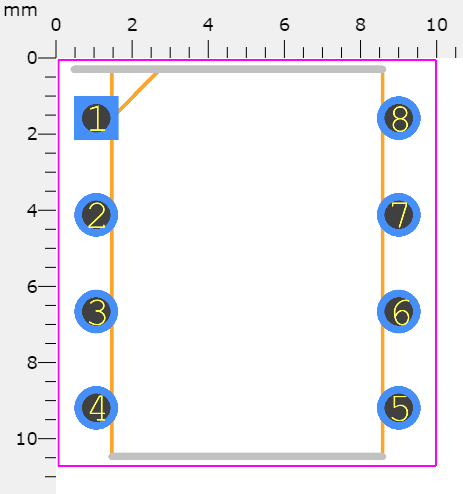
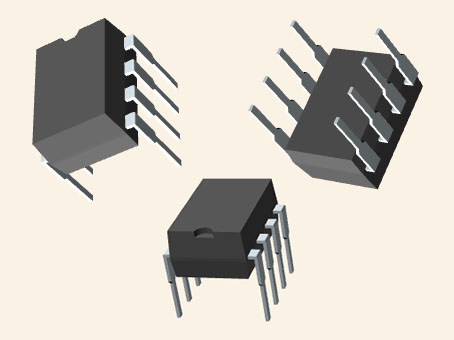
CA3140E Features
• MOSFET Input Stage
- Very High Input Impedance (ZIN) -1.5TΩ (Typ)
- Very Low Input Current (Il) -10pA (Typ) at ±15V
- Wide Common-Mode Input Voltage Range (VCR) - Can be Swung 0.5V Below Negative Supply Voltage Rail
- Output Swing Complements Input Common-Mode Range
• Directly Replaces Industry Type 741 in Most Applications
Specifications
- TypeParameter
- Mount
In electronic components, the term "Mount" typically refers to the method or process of physically attaching or fixing a component onto a circuit board or other electronic device. This can involve soldering, adhesive bonding, or other techniques to secure the component in place. The mounting process is crucial for ensuring proper electrical connections and mechanical stability within the electronic system. Different components may have specific mounting requirements based on their size, shape, and function, and manufacturers provide guidelines for proper mounting procedures to ensure optimal performance and reliability of the electronic device.
Through Hole - Package / Case
refers to the protective housing that encases an electronic component, providing mechanical support, electrical connections, and thermal management.
DIP - Contact Plating
Contact plating (finish) provides corrosion protection for base metals and optimizes the mechanical and electrical properties of the contact interfaces.
Lead, Tin - Number of Pins8
- Operating Temperature (Min)
The parameter "Operating Temperature (Min)" in electronic components refers to the minimum temperature at which the component is designed to operate effectively and reliably. This specification indicates the lowest temperature at which the component can function within its specified performance limits. Operating below this minimum temperature may result in reduced efficiency, slower response times, or even complete failure of the component. It is important to consider the operating temperature range of electronic components to ensure proper functionality and longevity in various environmental conditions.
-55°C - Frequency - Gain Bandwidth Product (GBP)3.7MHz
- Operating Temperature (Max)
The parameter "Operating Temperature (Max)" in electronic components refers to the maximum temperature at which the component can safely operate without experiencing damage or performance degradation. This specification is crucial for ensuring the reliability and longevity of the component in various operating conditions. Exceeding the maximum operating temperature can lead to thermal stress, reduced efficiency, and ultimately failure of the component. It is important for designers and engineers to consider this parameter when selecting and using electronic components to ensure proper functionality and prevent potential issues related to overheating.
125°C - Published1998
- JESD-609 Code
The "JESD-609 Code" in electronic components refers to a standardized marking code that indicates the lead-free solder composition and finish of electronic components for compliance with environmental regulations.
e0 - Pbfree Code
The "Pbfree Code" parameter in electronic components refers to the code or marking used to indicate that the component is lead-free. Lead (Pb) is a toxic substance that has been widely used in electronic components for many years, but due to environmental concerns, there has been a shift towards lead-free alternatives. The Pbfree Code helps manufacturers and users easily identify components that do not contain lead, ensuring compliance with regulations and promoting environmentally friendly practices. It is important to pay attention to the Pbfree Code when selecting electronic components to ensure they meet the necessary requirements for lead-free applications.
no - ECCN Code
An ECCN (Export Control Classification Number) is an alphanumeric code used by the U.S. Bureau of Industry and Security to identify and categorize electronic components and other dual-use items that may require an export license based on their technical characteristics and potential for military use.
EAR99 - Terminal Finish
Terminal Finish refers to the surface treatment applied to the terminals or leads of electronic components to enhance their performance and longevity. It can improve solderability, corrosion resistance, and overall reliability of the connection in electronic assemblies. Common finishes include nickel, gold, and tin, each possessing distinct properties suitable for various applications. The choice of terminal finish can significantly impact the durability and effectiveness of electronic devices.
Tin/Lead (Sn/Pb) - Voltage - Supply
Voltage - Supply refers to the range of voltage levels that an electronic component or circuit is designed to operate with. It indicates the minimum and maximum supply voltage that can be applied for the device to function properly. Providing supply voltages outside this range can lead to malfunction, damage, or reduced performance. This parameter is critical for ensuring compatibility between different components in a circuit.
9V - Terminal Position
In electronic components, the term "Terminal Position" refers to the physical location of the connection points on the component where external electrical connections can be made. These connection points, known as terminals, are typically used to attach wires, leads, or other components to the main body of the electronic component. The terminal position is important for ensuring proper connectivity and functionality of the component within a circuit. It is often specified in technical datasheets or component specifications to help designers and engineers understand how to properly integrate the component into their circuit designs.
DUAL - Peak Reflow Temperature (Cel)
Peak Reflow Temperature (Cel) is a parameter that specifies the maximum temperature at which an electronic component can be exposed during the reflow soldering process. Reflow soldering is a common method used to attach electronic components to a circuit board. The Peak Reflow Temperature is crucial because it ensures that the component is not damaged or degraded during the soldering process. Exceeding the specified Peak Reflow Temperature can lead to issues such as component failure, reduced performance, or even permanent damage to the component. It is important for manufacturers and assemblers to adhere to the recommended Peak Reflow Temperature to ensure the reliability and functionality of the electronic components.
NOT SPECIFIED - Number of Functions1
- Terminal Pitch
The center distance from one pole to the next.
2.54mm - Time@Peak Reflow Temperature-Max (s)
Time@Peak Reflow Temperature-Max (s) refers to the maximum duration that an electronic component can be exposed to the peak reflow temperature during the soldering process, which is crucial for ensuring reliable solder joint formation without damaging the component.
NOT SPECIFIED - Qualification Status
An indicator of formal certification of qualifications.
Not Qualified - Temperature Grade
Temperature grades represent a tire's resistance to heat and its ability to dissipate heat when tested under controlled laboratory test conditions.
MILITARY - Supply Current-Max
Supply Current-Max refers to the maximum amount of current that an electronic component or circuit can draw from its power supply under specified operating conditions. It is a critical parameter that determines the power consumption and thermal performance of the device. Exceeding this limit can lead to overheating, potential damage, or failure of the component. Knowing the Supply Current-Max helps in designing circuits that ensure proper operation and reliability.
6mA - Current - Supply
Current - Supply is a parameter in electronic components that refers to the maximum amount of electrical current that the component can provide to the circuit it is connected to. It is typically measured in units of amperes (A) and is crucial for determining the power handling capability of the component. Understanding the current supply rating is important for ensuring that the component can safely deliver the required current without overheating or failing. It is essential to consider this parameter when designing circuits to prevent damage to the component and ensure proper functionality of the overall system.
4mA - Slew Rate
the maximum rate of output voltage change per unit time.
9 V/μs - Architecture
In electronic components, the parameter "Architecture" refers to the overall design and structure of the component. It encompasses the arrangement of internal components, the layout of circuitry, and the physical form of the component. The architecture of an electronic component plays a crucial role in determining its functionality, performance, and compatibility with other components in a system. Different architectures can result in variations in power consumption, speed, size, and other key characteristics of the component. Designers often consider the architecture of electronic components carefully to ensure optimal performance and integration within a larger system.
VOLTAGE-FEEDBACK - Amplifier Type
Amplifier Type refers to the classification or categorization of amplifiers based on their design, functionality, and characteristics. Amplifiers are electronic devices that increase the amplitude of a signal, such as voltage or current. The type of amplifier determines its specific application, performance capabilities, and operating characteristics. Common types of amplifiers include operational amplifiers (op-amps), power amplifiers, audio amplifiers, and radio frequency (RF) amplifiers. Understanding the amplifier type is crucial for selecting the right component for a particular circuit or system design.
OPERATIONAL AMPLIFIER - Common Mode Rejection Ratio
Common Mode Rejection Ratio (CMRR) is a measure of the ability of a differential amplifier to reject input signals that are common to both input terminals. It is defined as the ratio of the differential gain to the common mode gain. A high CMRR indicates that the amplifier can effectively eliminate noise and interference that affects both inputs simultaneously, enhancing the fidelity of the amplified signal. CMRR is typically expressed in decibels (dB), with higher values representing better performance in rejecting common mode signals.
90 dB - Current - Input Bias
The parameter "Current - Input Bias" in electronic components refers to the amount of current required at the input terminal of a device to maintain proper operation. It is a crucial specification as it determines the minimum input current needed for the component to function correctly. Input bias current can affect the performance and accuracy of the device, especially in precision applications where small signal levels are involved. It is typically specified in datasheets for operational amplifiers, transistors, and other semiconductor devices to provide users with important information for circuit design and analysis.
10pA - Output Current per Channel
Output Current per Channel is a specification commonly found in electronic components such as amplifiers, audio interfaces, and power supplies. It refers to the maximum amount of electrical current that can be delivered by each individual output channel of the component. This parameter is important because it determines the capacity of the component to drive connected devices or loads. A higher output current per channel means the component can deliver more power to connected devices, while a lower output current may limit the performance or functionality of the component in certain applications. It is crucial to consider the output current per channel when selecting electronic components to ensure they can meet the power requirements of the intended system or setup.
40mA - Input Offset Voltage (Vos)
Input Offset Voltage (Vos) is a key parameter in electronic components, particularly in operational amplifiers. It refers to the voltage difference that must be applied between the two input terminals of the amplifier to nullify the output voltage when the input terminals are shorted together. In simpler terms, it represents the voltage required to bring the output of the amplifier to zero when there is no input signal present. Vos is an important parameter as it can introduce errors in the output signal of the amplifier, especially in precision applications where accuracy is crucial. Minimizing Vos is essential to ensure the amplifier operates with high precision and accuracy.
5mV - Neg Supply Voltage-Nom (Vsup)
The parameter "Neg Supply Voltage-Nom (Vsup)" in electronic components refers to the nominal negative supply voltage that the component requires to operate within its specified performance characteristics. This parameter indicates the minimum voltage level that must be provided to the component's negative supply pin for proper functionality. It is important to ensure that the negative supply voltage provided to the component does not exceed the maximum specified value to prevent damage or malfunction. Understanding and adhering to the specified negative supply voltage requirements is crucial for the reliable operation of the electronic component in a circuit.
-15V - Unity Gain BW-Nom
Unity Gain Bandwidth, often abbreviated as Unity Gain BW or UGBW, refers to the frequency at which an amplifier can provide a gain of one (0 dB). It is a critical parameter in assessing the performance of operational amplifiers and other amplifying devices, indicating the range of frequencies over which the amplifier can operate without distortion. Unity Gain BW is particularly important in applications where signal fidelity is crucial, as it helps determine the maximum frequency of operation for a given gain level. As the gain is reduced, the bandwidth typically increases, ensuring that the amplifier can still operate effectively across various signal frequencies.
4500 kHz - Voltage Gain
Voltage gain is a measure of how much an electronic component or circuit amplifies an input voltage signal to produce an output voltage signal. It is typically expressed as a ratio or in decibels (dB). A higher voltage gain indicates a greater amplification of the input signal. Voltage gain is an important parameter in amplifiers, where it determines the level of amplification provided by the circuit. It is calculated by dividing the output voltage by the input voltage and is a key factor in determining the overall performance and functionality of electronic devices.
100dB - Low-Offset
Low-offset is a parameter used to describe the level of offset voltage in electronic components, particularly in operational amplifiers. Offset voltage refers to the small voltage difference that exists between the input terminals of the amplifier when the input voltage is zero. A low-offset value indicates that this voltage difference is minimal, which is desirable for accurate signal processing and amplification. Components with low-offset specifications are preferred in applications where precision and accuracy are critical, such as in instrumentation and measurement systems. Minimizing offset voltage helps reduce errors and ensures the faithful reproduction of input signals by the amplifier.
NO - Frequency Compensation
Frequency compensation is implemented by modifying the gain and phase characteristics of the amplifier's open loop output or of its feedback network, or both, in such a way as to avoid the conditions leading to oscillation. This is usually done by the internal or external use of resistance-capacitance networks.
YES - Max Dual Supply Voltage
A Dual power supply is a regular direct current power supply. It can provide a positive as well as negative voltage. It ensures stable power supply to the device as well as it helps to prevent system damage.
18V - Low-Bias
Low-bias in electronic components refers to a design or configuration that minimizes the amount of bias current flowing through the component. Bias current is a small, steady current that is used to establish the operating point of a component, such as a transistor or amplifier. By reducing the bias current to a low level, the component can operate with lower power consumption and potentially lower distortion. Low-bias components are often used in applications where power efficiency and signal fidelity are important, such as in audio amplifiers or battery-powered devices. Overall, the low-bias parameter indicates the ability of the component to operate efficiently and accurately with minimal bias current.
YES - Min Dual Supply Voltage
The parameter "Min Dual Supply Voltage" in electronic components refers to the minimum voltage required for the proper operation of a device that uses dual power supplies. Dual power supplies typically consist of a positive and a negative voltage source. The "Min Dual Supply Voltage" specification ensures that both the positive and negative supply voltages are within a certain range to guarantee the device functions correctly. It is important to adhere to this parameter to prevent damage to the component and ensure reliable performance.
2V - Bias Current-Max (IIB) @25C
The parameter "Bias Current-Max (IIB) @25C" in electronic components refers to the maximum input bias current that the component can handle at a specified temperature of 25 degrees Celsius. Bias current is the current flowing into the input terminal of a device when no signal is applied. This parameter is important because excessive bias current can affect the performance and stability of the component, leading to potential issues such as distortion or offset errors in the output signal. By specifying the maximum bias current allowed at a certain temperature, manufacturers provide users with important information to ensure proper operation and reliability of the component in their circuit designs.
0.00005μA - Dual Supply Voltage
Dual Supply Voltage refers to an electronic component's requirement for two separate power supply voltages, typically one positive and one negative. This configuration is commonly used in operational amplifiers, analog circuits, and certain digital devices to allow for greater signal handling capabilities and improved performance. The use of dual supply voltages enables the device to process bipolar signals, thereby enhancing its functionality in various applications.
9V - Voltage - Supply (Max)
Voltage - Supply (Max) is a parameter in electronic components that specifies the maximum voltage that can be safely applied to the component for proper operation. This parameter is crucial for ensuring the component's longevity and preventing damage due to overvoltage conditions. Exceeding the maximum supply voltage can lead to component failure, reduced performance, or even permanent damage. Designers must carefully consider this parameter when selecting components and designing circuits to ensure reliable and safe operation within the specified voltage limits.
36V - Voltage - Supply (Min)
Voltage - Supply (Min) is a parameter in electronic components that specifies the minimum voltage required for the component to operate within its specified performance range. This parameter indicates the lowest voltage level that can be safely applied to the component without causing malfunctions or damage. It is crucial to ensure that the supply voltage provided to the component is equal to or higher than the specified minimum voltage to guarantee proper functionality and reliability. Failure to meet this requirement may result in erratic behavior, reduced performance, or even permanent damage to the component.
4V - Number of Amplifiers1
- Width7.11mm
- Height4.95mm
- Length10.16mm
- REACH SVHC
The parameter "REACH SVHC" in electronic components refers to the compliance with the Registration, Evaluation, Authorization, and Restriction of Chemicals (REACH) regulation regarding Substances of Very High Concern (SVHC). SVHCs are substances that may have serious effects on human health or the environment, and their use is regulated under REACH to ensure their safe handling and minimize their impact.Manufacturers of electronic components need to declare if their products contain any SVHCs above a certain threshold concentration and provide information on the safe use of these substances. This information allows customers to make informed decisions about the potential risks associated with using the components and take appropriate measures to mitigate any hazards.Ensuring compliance with REACH SVHC requirements is essential for electronics manufacturers to meet regulatory standards, protect human health and the environment, and maintain transparency in their supply chain. It also demonstrates a commitment to sustainability and responsible manufacturing practices in the electronics industry.
No SVHC - RoHS Status
RoHS means “Restriction of Certain Hazardous Substances” in the “Hazardous Substances Directive” in electrical and electronic equipment.
RoHS Compliant
Parts with Similar Specs
- ImagePart NumberManufacturerPackage / CaseNumber of PinsSlew RateGain Bandwidth ProductInput Offset Voltage (Vos)Common Mode Rejection RatioSupply VoltageMin Supply VoltageMin Dual Supply VoltageMax Supply VoltageMax Dual Supply VoltageView Compare
![CA3140E]()
CA3140E
DIP
8
9 V/μs
3.7 MHz
5 mV
90 dB
15 V
4 V
2 V
36 V
18 V
![LM741CN]()
8-DIP (0.300, 7.62mm)
8
0.5V/μs
1.5MHz
6 mV
70 dB
15 V
-
-
-
-
![CA3140AE]()
DIP
8
9 V/μs
4.5 MHz
2 mV
90 dB
15 V
4 V
2 V
36 V
18 V
![LM10CN/NOPB]()
8-DIP (0.300, 7.62mm)
8
0.2 V/μs
90 kHz
4 mV
90 dB
20 V
-
-
-
-
![LT1007CN8]()
8-DIP (0.300, 7.62mm)
8
2.5V/μs
8MHz
10 μV
110 dB
-
4 V
2 V
44 V
22 V


CA3140E Functional Block Diagram
CA3140E Schematic Diagram
Where to use the CA3140 IC
CA3140 is a single-package Op-Amp that has long been popular among engineers and students. This Op-Amp can be utilized in a variety of applications, including voltage followers, buffers, comparators, amplifiers, adders, and more. So, if you're seeking for a simple Op-Amp to use in any basic circuit design, this IC might be the appropriate fit.
How to use the CA3140 IC
The CA3140 Op Amp and the CA3240 Op Amp are quite similar. The key difference is that the CA3240 contains two Op-Amps, making it more cost-effective and compact.
The CA3140 Op-Amp contains two Offset Null pins, which is a remarkable feature (pin1 and pin 5). These two pins can be utilized to fix an Op-offset Amp's error. When the voltage difference between the inverting and non-inverting pins is 0, the Op-output Amp's voltage should be zero as well. If not, the error is referred to as an offset error, which can be corrected by applying an offset voltage to the offset pins, which will cancel the error.
Below is a test circuit based on the CA3140 datasheet.
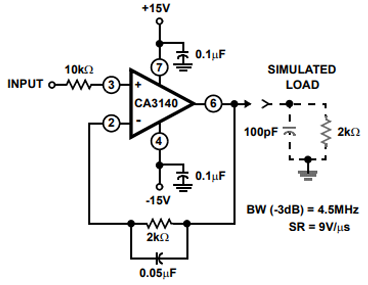
A Test Circuit from the CA3140
CA3140 Equivalent
UA741
Alternatives Audio Amplifiers: LM4871, AD620, IC6283, JRC45558, TL081, LF351N, MC33171N
CA3140E Alternatives
| Part Number | Description | Manufacturer |
| CA3140EZAMPLIFIER CIRCUITS | 4.5MHz, BiMOS Operational Amplifier with MOSFET Input/Bipolar Output | Renesas Electronics Corporation |
CA3140E Applications
• Ground-Referenced Single Supply Amplifiers in Automobile and Portable Instrumentation
• Sample and Hold Amplifiers
• Long Duration Timers/Multivibrators (µseconds-Minutes-Hours)
• Photocurrent Instrumentation
• Peak Detectors
• Active Filters
• Comparators
• Interface in 5V TTL Systems and Other Low Supply Voltage Systems
• All Standard Operational Amplifier Applications
• Function Generators
• Tone Controls
• Power Supplies
• Portable Instruments
• Intrusion Alarm Systems
• Automotive
• Portable Devices
• Sensing & Instrumentation
• Power Management
CA3140E Package
Dimensions for the CA3140 IC is given below. These dimensions are for the SOIC package. If you are using different package IC please refer to the CA3140 datasheet.
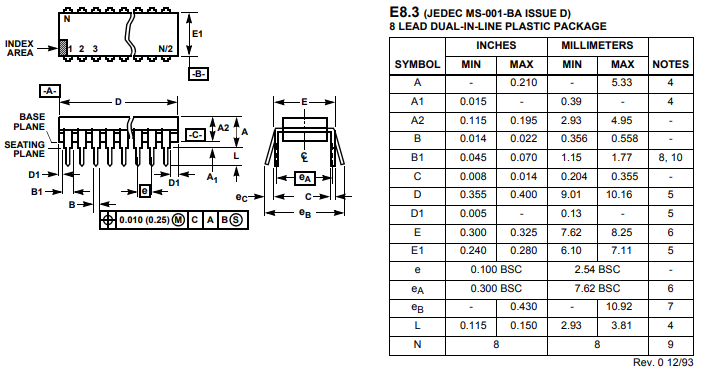
Package
CA3140E Manufacturer
Renesas and Intersil will merge on January 1, 2018, resulting in a considerable increase in semiconductor inherent capabilities. Intersil's market-leading expertise in high-performance power management and precision analog devices is combined with Renesas' globally regarded MCU and SoC technologies. As a result, organic expansion in the automotive, industrial, and broad-based industries occurs, allowing the new company to respond more quickly to clients' system requirements. The merger of Renesas and Intersil began on February 24, 2017, with the completion of the acquisition, and the unified "One Global Renesas" went into operation across all markets the following July, bringing together the strengths of both companies in anticipation of customer needs in a rapidly changing market environment. This genuinely worldwide company has a tremendous amount of synergy. Join Renesas as it improves its position as the world's premier semiconductor manufacturer.
Trend Analysis
Datasheet PDF
- Datasheets :
Can the voltage follower made by CA3140 follow the negative voltage?
Of course, you have to pay attention to these prerequisites:
1. The CA3140 must be powered by dual power supplies. If it is a symmetrical positive and negative voltage, it is best to analyze and implement it. negative 15V);
2. The negative voltage in the supply voltage should be lower than your follower voltage, preferably 2-3V or more.
What type of chip is the CA3140E?
Single Monolithic Chip.
What does the CA3140E provide an access terminal for if further frequency roll-off is needed?
An Extra External Capacitor.
 ADA4610-2 JFET Dual Op-Amp: Pinout, Equivalent and Datasheet
10 December 20213617
 MB10S Bridge Rectifier: Circuit, Pinout, and Datasheet
15 November 20217260
 TDA7265 Audio Amplifier: Pinout, Datasheet, and Application Circuits
21 July 202123494
 CC2640R2FRGZR:Wireless Microcontroller, Bluetooth® 5.1 Low Energy, CC2640R2F VS. CC2640R2L
03 March 20222567
 88E1512-A0-NNP2C000 Energy-Efficient Ethernet Transceiver: Features, Pinout, and Datasheet
21 February 20224539
 T491C335M035AT Standard Tantalum Surface Capacitors:Pinout,Application and Advantages
18 September 2021429
 TLV271 Operational Amplifier: Pinout, Features and Datasheet
11 November 20211332
 Designing with AD9850: Datasheet, Pinout, and Sine Wave Synthesis Guide
05 February 2026311
 Low-Power Design of Operational Amplifiers
27 March 20257533
 ON Semiconductor Provides Soft Fourth-Quarter Guidance. The Stock Drops.
13 March 20243098
 An Overview of LPDDR
25 August 202639012
 Apple Will Help TSMC to Be in the Leading Position in the Next Era
16 March 20223509
 Comprehensive Analysis of Each Functional Circuit of Switching Power Supply
06 May 20225920
 HIKSEMI Authorized Distributor | UTMEL Electronics
15 November 20234226
 Samsung: 3nm Yield Rate of 20%
19 April 20225564
 How to Distinguish MOSFET? Is it N-Channel or P-Channel?
23 December 202111502
Intersil (Renesas Electronics America)
In Stock
United States
China
Canada
Japan
Russia
Germany
United Kingdom
Singapore
Italy
Hong Kong(China)
Taiwan(China)
France
Korea
Mexico
Netherlands
Malaysia
Austria
Spain
Switzerland
Poland
Thailand
Vietnam
India
United Arab Emirates
Afghanistan
Åland Islands
Albania
Algeria
American Samoa
Andorra
Angola
Anguilla
Antigua & Barbuda
Argentina
Armenia
Aruba
Australia
Azerbaijan
Bahamas
Bahrain
Bangladesh
Barbados
Belarus
Belgium
Belize
Benin
Bermuda
Bhutan
Bolivia
Bonaire, Sint Eustatius and Saba
Bosnia & Herzegovina
Botswana
Brazil
British Indian Ocean Territory
British Virgin Islands
Brunei
Bulgaria
Burkina Faso
Burundi
Cabo Verde
Cambodia
Cameroon
Cayman Islands
Central African Republic
Chad
Chile
Christmas Island
Cocos (Keeling) Islands
Colombia
Comoros
Congo
Congo (DRC)
Cook Islands
Costa Rica
Côte d’Ivoire
Croatia
Cuba
Curaçao
Cyprus
Czechia
Denmark
Djibouti
Dominica
Dominican Republic
Ecuador
Egypt
El Salvador
Equatorial Guinea
Eritrea
Estonia
Eswatini
Ethiopia
Falkland Islands
Faroe Islands
Fiji
Finland
French Guiana
French Polynesia
Gabon
Gambia
Georgia
Ghana
Gibraltar
Greece
Greenland
Grenada
Guadeloupe
Guam
Guatemala
Guernsey
Guinea
Guinea-Bissau
Guyana
Haiti
Honduras
Hungary
Iceland
Indonesia
Iran
Iraq
Ireland
Isle of Man
Israel
Jamaica
Jersey
Jordan
Kazakhstan
Kenya
Kiribati
Kosovo
Kuwait
Kyrgyzstan
Laos
Latvia
Lebanon
Lesotho
Liberia
Libya
Liechtenstein
Lithuania
Luxembourg
Macao(China)
Madagascar
Malawi
Maldives
Mali
Malta
Marshall Islands
Martinique
Mauritania
Mauritius
Mayotte
Micronesia
Moldova
Monaco
Mongolia
Montenegro
Montserrat
Morocco
Mozambique
Myanmar
Namibia
Nauru
Nepal
New Caledonia
New Zealand
Nicaragua
Niger
Nigeria
Niue
Norfolk Island
North Korea
North Macedonia
Northern Mariana Islands
Norway
Oman
Pakistan
Palau
Palestinian Authority
Panama
Papua New Guinea
Paraguay
Peru
Philippines
Pitcairn Islands
Portugal
Puerto Rico
Qatar
Réunion
Romania
Rwanda
Samoa
San Marino
São Tomé & Príncipe
Saudi Arabia
Senegal
Serbia
Seychelles
Sierra Leone
Sint Maarten
Slovakia
Slovenia
Solomon Islands
Somalia
South Africa
South Sudan
Sri Lanka
St Helena, Ascension, Tristan da Cunha
St. Barthélemy
St. Kitts & Nevis
St. Lucia
St. Martin
St. Pierre & Miquelon
St. Vincent & Grenadines
Sudan
Suriname
Svalbard & Jan Mayen
Sweden
Syria
Tajikistan
Tanzania
Timor-Leste
Togo
Tokelau
Tonga
Trinidad & Tobago
Tunisia
Turkey
Turkmenistan
Turks & Caicos Islands
Tuvalu
U.S. Outlying Islands
U.S. Virgin Islands
Uganda
Ukraine
Uruguay
Uzbekistan
Vanuatu
Vatican City
Venezuela
Wallis & Futuna
Yemen
Zambia
Zimbabwe
![ISL55001IBZ-T7]() ISL55001IBZ-T7
ISL55001IBZ-T7Intersil (Renesas Electronics America)
![ISL28210FBZ]() ISL28210FBZ
ISL28210FBZIntersil (Renesas Electronics America)
![EL5175IS]() EL5175IS
EL5175ISIntersil (Renesas Electronics America)
![ISL28213FUZ-T7]() ISL28213FUZ-T7
ISL28213FUZ-T7Intersil (Renesas Electronics America)
![CA3130EZ]() CA3130EZ
CA3130EZIntersil (Renesas Electronics America)
![ISL28158FBZ]() ISL28158FBZ
ISL28158FBZIntersil (Renesas Electronics America)
![CA3140EZ]() CA3140EZ
CA3140EZIntersil (Renesas Electronics America)
![ISL55002IBZ-T7]() ISL55002IBZ-T7
ISL55002IBZ-T7Intersil (Renesas Electronics America)
![CA3140AEZ]() CA3140AEZ
CA3140AEZIntersil (Renesas Electronics America)


